

How Faculty Review Dental Assignments Fairly
A preparation may look acceptable from a distance and still lose critical points at the bench. A marginal ridge may not be properly formed. The taper may be excessive. The finish line may be irregular, unsupported, or difficult to identify. This is why understanding how faculty review dental assignments matters as much as practicing the procedure itself.
For internationally trained dentists preparing for U.S. bench exams or advanced standing programs, faculty review is not a simple approval process. It is a standards-based evaluation of whether the work demonstrates control, accuracy, and repeatable clinical judgment under the criteria used in U.S. dental education.
Faculty Review Is Built Around Observable Standards
Faculty cannot grade what a learner intended to do. They evaluate what is visible in the submitted preparation, restoration, wax-up, or other assigned exercise. The review begins with the rubric or performance criteria for that procedure and compares the work to the expected clinical outcome.
For a crown preparation, that may include occlusal reduction, axial reduction, total occlusal convergence, finish-line design, clearance, path of insertion, and preservation of appropriate tooth structure. For a Class II preparation, the evaluation may focus on outline form, pulpal and axial wall depth, proximal clearance, retention, internal angles, and protection of adjacent teeth. The exact priorities depend on the assignment and exam format, but the principle remains consistent: every feature must support the procedure’s functional and biologic requirements.
A faculty reviewer also considers whether the work would remain acceptable when examined closely, not only when photographed from one favorable angle. Bench exams reward consistency. A preparation that appears clean in a single view but reveals uneven reduction or an unsupported margin from another angle is not yet exam-ready.
How Faculty Review Dental Assignments Step by Step
The strongest review process follows a sequence. It prevents the evaluator from being distracted by one impressive feature while missing a major technical error elsewhere.
First, the faculty member checks the assignment requirements
Before analyzing fine details, the reviewer confirms that the learner completed the correct procedure and submitted the required views. This matters because appropriate documentation is part of professional communication. If the submitted photos are poorly lit, out of focus, or missing an essential angle, faculty may be unable to assess a critical portion of the work.
Clear images also train candidates to inspect their own preparations. If you cannot show a finish line clearly, ask whether you can truly evaluate its continuity and quality yourself.
Next, the reviewer evaluates major form and reduction
Faculty typically identify high-impact issues first. These are the errors most likely to compromise the restoration, violate the rubric, or result in substantial point deductions. Examples include inadequate occlusal clearance, excessive taper, an incorrect path of draw, over-reduction, under-reduction, or damage to an adjacent tooth.
This stage is intentionally practical. A beautiful margin does not compensate for a preparation with insufficient clearance. Likewise, acceptable reduction alone does not compensate for a path of insertion that prevents proper seating. Faculty review looks at the procedure as a complete clinical form, not as separate isolated details.
Then, the reviewer inspects margins, contours, and details
Once the major requirements are evaluated, attention moves to refinement. Is the chamfer or shoulder smooth, continuous, and correctly positioned? Are line angles rounded where they should be? Are internal walls free of gouges? Does the transition between surfaces reflect purposeful handpiece control?
These details often separate a borderline submission from a competitive one. They also reveal whether a learner is using a repeatable process rather than correcting problems randomly at the end.
Finally, faculty provide actionable feedback
Effective feedback identifies the issue, explains why it matters, and directs the next correction. “Improve your preparation” is too vague to guide meaningful progress. A useful evaluation might indicate that the distal margin lacks continuity, that lingual reduction is insufficient, or that the proximal wall requires more clearance without extending the preparation unnecessarily.
At Global Dental Elites Academy, this feedback loop is designed to connect faculty evaluation with structured resubmission. The goal is not merely to identify a defect. It is to help the candidate correct the defect, demonstrate the correction, and build a more reliable technique for the next procedure.
What Faculty Look for Beyond the Final Result
The final model is important, but reviewers also look for signs of clinical discipline. A submission can reveal whether the candidate has a dependable sequence for reduction, measurement, refinement, and verification.
For example, a consistently under-reduced occlusal surface may suggest that the learner is not using depth orientation grooves effectively or is not verifying clearance with an appropriate index. Rough, inconsistent margins may indicate that the finishing phase is rushed or that the selected bur is not being controlled with stable finger rests. Repeated over-taper may point to handpiece angulation rather than a lack of knowledge about the ideal convergence.
This distinction matters because exam preparation is not about fixing one model. It is about producing an acceptable result repeatedly, even when time pressure increases. Faculty feedback should therefore address both the visible error and the working habit that caused it.
Why Resubmission Produces Better Bench Skills
A single review can clarify what is wrong. Resubmission proves whether the correction has become a skill.
Many candidates make an understandable mistake after receiving feedback: they try to correct every issue at once. That can create new problems. If you aggressively reduce a surface to improve clearance, you may lose proper contour or create excessive taper. If you widen a proximal area for clearance, you may overextend the outline form. Faculty review helps prioritize corrections so that each adjustment protects the rest of the preparation.
A disciplined resubmission cycle also teaches self-assessment. Before submitting again, compare the work against the feedback point by point. Verify reduction, inspect the margin from multiple angles, examine the path of insertion, and ask whether the correction is visible rather than assumed. This is the same habit that helps candidates make sound decisions during a timed bench examination.
The Trade-Offs Faculty Expect You to Understand
Dental procedures are rarely judged by one measurement alone. Faculty expect candidates to balance competing demands without sacrificing the rubric.
More reduction may improve clearance, but excessive reduction can weaken the preparation or remove unnecessary tooth structure. A wider margin can be easier to visualize, but it must still be smooth, appropriate for the restorative material, and placed with control. Increasing proximal clearance may improve access, yet excessive extension can harm the overall form.
This is where experienced faculty evaluation has particular value. The correct correction depends on the current condition of the work. There is no universal instruction to “reduce more” or “open the contact more.” The reviewer must determine what will bring that specific submission closer to the required standard with the least disruption to the features that are already acceptable.
How to Submit Work That Can Be Evaluated Accurately
Faculty review is most useful when the submission makes the work visible. Follow the assignment instructions exactly, use adequate lighting, and provide each required angle. Keep the preparation clean and free of debris that can hide a margin or create the appearance of an irregular surface.
Before taking photographs, inspect the work as if you were the evaluator. Check the occlusal view, buccal and lingual aspects, proximal areas, and any view needed to assess clearance or draw. Use the rubric as a checklist, but do not rely on the checklist alone. Ask whether the preparation appears intentional, balanced, and clinically serviceable.
If you are unsure about a point, submit the work rather than waiting for perfection. High-quality faculty feedback is designed to reduce uncertainty. The value comes from receiving a precise standard, applying the correction, and seeing your work improve through repetition.
Train for the Evaluation, Not Just the Procedure
Bench exam performance improves when you stop viewing feedback as a score and start using it as a clinical calibration tool. Each faculty comment gives you a clearer picture of how U.S. dental standards are applied to your hands, your instruments, and your decision-making.
Approach every assignment with the mindset that your next submission should show a measurable improvement, not simply more effort. That is how individual corrections become dependable performance – and how confident candidates earn their place at the bench.
You May Also Like

Use this international dentist admission pathway guide to plan credentialing, bench exams, applications, and feedback-led preparation for U.S. programs.
-
-
July 27, 2026
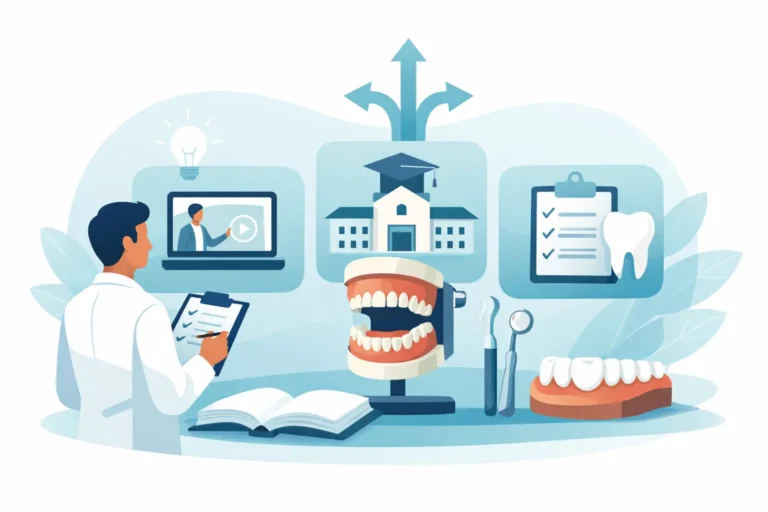
Use this bench exam course selection guide to compare feedback, curriculum, timing, and hands-on support before choosing U.S. dental training...
-
-
July 25, 2026

Learn what is bench exam evaluation, how U.S. dental schools score your work, and how targeted faculty feedback strengthens exam...
-
-
July 23, 2026