

Virtual Bench Exam Training That Builds Results
A handpiece, a typodont, and a video lesson are not enough when your result will be judged against U.S. bench exam criteria. What most candidates need is virtual bench exam training that shows the standard clearly, then measures their work against it with faculty-calibrated feedback. That difference matters because many internationally trained dentists are not starting from zero – they are adapting strong clinical foundations to a new evaluation system.
Bench exams are demanding for a simple reason: they test more than manual skill. They test whether your preparation design, finish quality, dimensions, reduction, margins, and overall execution match the expectations of a U.S. dental school or licensure pathway. If your training does not reflect those expectations with precision, you may practice extensively and still improve in the wrong direction.
What virtual bench exam training should actually do
The best virtual training is not a passive library of demonstrations. It should function as a guided preparation system. That means you watch calibrated faculty demonstrations, complete the same type of exercise yourself, submit your work, receive written evaluation, and then correct the deficiencies through a structured resubmission process.
This matters because bench preparation is rarely improved by repetition alone. Repetition without correction often reinforces the same weak margin, the same taper issue, or the same depth inconsistency. A serious training model identifies the exact gap between your current work and exam-level performance, then gives you a disciplined path to close it.
For internationally trained dentists, that structure solves one of the biggest preparation problems: uncertainty. Many candidates do not know whether a result is acceptable, almost acceptable, or far below standard. They may rely on peer opinions, social media examples, or self-assessment. None of those replaces faculty review aligned with actual grading logic.
Why virtual bench exam training works for serious candidates
There is still a common misconception that hands-on bench preparation must happen only in person. In reality, virtual bench exam training can be highly effective when it is built around clear demonstrations, assignment-based learning, and expert review. The format itself is not the deciding factor. The quality of instruction and feedback is.
A strong virtual model gives candidates flexibility without lowering standards. Most internationally trained dentists are balancing family obligations, immigration logistics, financial planning, and exam timelines. They need training that fits real life while still pushing performance upward. Asynchronous learning helps because it lets you repeat demonstrations, pause at critical steps, and train consistently on your schedule.
The trade-off is that flexibility only helps if accountability remains in place. If a course gives you videos but no review, you may feel productive without becoming exam-ready. If a course includes direct faculty evaluation with a defined turnaround, the virtual format becomes an advantage rather than a compromise. You gain time efficiency and expert guidance together.
The feedback loop that improves bench performance
Bench exam success usually comes from refinement, not a single breakthrough. That is why the feedback loop is central to effective preparation.
First, you need a demonstration that does more than show the procedure. It should explain what the evaluator is looking for, where candidates lose points, and how small technical errors affect the overall grade. Then you need to produce your own work under controlled conditions and submit it for review.
The review should be specific. General comments such as “good work” or “needs improvement” are not enough. Useful evaluation points to measurable issues: unsupported enamel, over-taper, under-reduction, rough finish, open contact, broken outline form, or margin inconsistency. Once those points are identified, the next step is not just to move on – it is to revise and resubmit until the work moves closer to standard.
That cycle builds technical consistency and judgment at the same time. You begin to see your own work more accurately. Over time, that internal calibration becomes one of your greatest advantages on exam day.
What to look for in a virtual bench exam training program
Not all programs are built with the same level of rigor. If your goal is U.S. bench exam readiness, the course should be designed around exam performance rather than general continuing education.
Look first for alignment with U.S. dental standards. This sounds obvious, but it is often missing. A program may teach a procedure competently while still failing to reflect the exact expectations of advanced standing programs or bench exam scoring criteria.
Second, look for faculty involvement. Expert review matters because candidates often cannot identify subtle but grade-limiting errors on their own. A faculty-led process gives you a more reliable standard and reduces wasted practice time.
Third, look for a defined submission structure. A serious training system should tell you how many assignments are included, how feedback is delivered, and whether resubmission is part of the process. Improvement is much harder when the training path is vague.
Fourth, consider whether the course teaches performance under pressure, not just isolated technique. Bench exams are timed and stressful. It is one thing to prepare a tooth carefully over an open-ended practice session. It is another to do it under realistic exam constraints while maintaining quality.
This is where programs such as Global Dental Elites Academy stand apart – not by offering access alone, but by creating a standards-based system that combines faculty demonstrations, written evaluation, and structured improvement around the actual skills candidates need to present confidently.
Where candidates usually struggle
Many internationally trained dentists are clinically capable but exam-inconsistent. That distinction is important. You may know the procedure and still lose points because the final result does not meet a narrow grading threshold.
One common problem is overestimating visual acceptability. A preparation may look clean at first glance but fail on reduction depth, wall convergence, margin continuity, or surface smoothness. Another issue is transferring habits from previous training environments that do not match U.S. expectations. What was acceptable in one system may be graded strictly in another.
Time management is also a major factor. Some candidates can produce strong work eventually but not within exam timing. Others rush and sacrifice finish quality. Effective virtual preparation should address both the technical endpoint and the process used to get there.
There is also the psychological side. Bench exams create pressure because the outcome affects admissions, licensure progress, and career direction. Structured training helps reduce that pressure by replacing guesswork with evidence. When you have completed repeated exercises, received calibrated feedback, and corrected the same issue more than once, confidence becomes more realistic and more stable.
Virtual training versus in-person training
For many candidates, this is not an either-or decision. Virtual training is often the foundation, while in-person practice can be the final performance check.
Virtual preparation is ideal for building repetition, understanding criteria, and receiving staged feedback over time. It supports steady development and allows you to practice without waiting for a limited in-person session. It is especially effective during the early and middle phases of preparation, when your main task is to build accuracy and consistency.
In-person training becomes more valuable when you are close to exam level and need direct supervision under realistic conditions. It can help expose timing issues, ergonomic habits, and stress-related breakdowns that may not fully appear during home practice.
The right approach depends on your current level. If you are still correcting major technical errors, virtual faculty-guided training may give you the highest return first. If your work is already strong and you need final calibration under pressure, in-person training may become more useful. Strong candidates often benefit from both, used in the right sequence.
How to get more from virtual bench exam training
Treat your course like a performance system, not content consumption. Watch demonstrations actively. Compare faculty benchmarks to your own work. Submit assignments on schedule. Review every comment carefully, then repeat the procedure with a single correction goal in mind rather than trying to fix everything at once.
Document your progress. Save photos or videos of your work across submission rounds. This creates a visible record of improvement and helps you notice patterns. If the same issue appears repeatedly, that is valuable information. It tells you where to focus your next block of training.
Be honest about your weak points. Some candidates prefer to practice only the procedures they already perform well because it feels productive. That approach is comfortable, but it does not move scores. Growth usually comes from repeated work on the preparations that expose your limitations most clearly.
Virtual bench exam training works best when you respect the standard, accept correction quickly, and stay consistent long enough for the refinement to show in your hands.
Your goal is not to practice more than everyone else. Your goal is to practice against the right standard, with the right feedback, until your work holds up when it matters most.
You May Also Like

Understand foreign dentist eligibility for U.S. licensure, advanced standing programs, and bench exams with a focused, standards-based preparation plan.
-
-
October 26, 2026
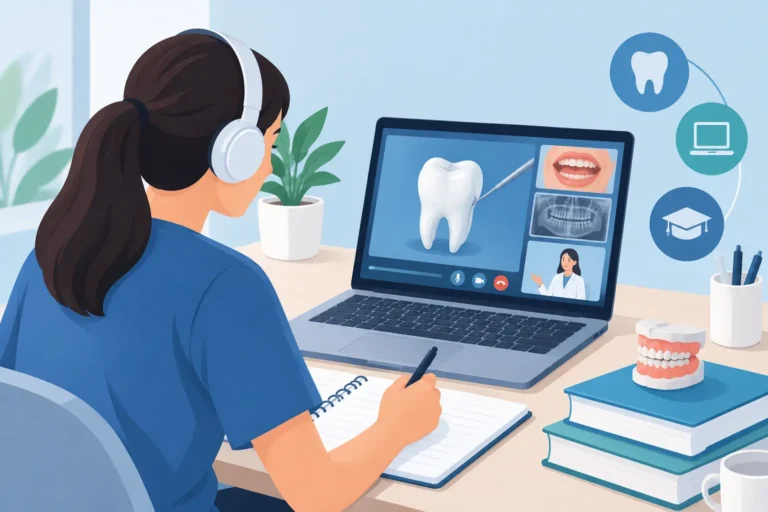
Virtual dental education for internationally trained dentists: learn U.S. bench standards, submit work for faculty review, and improve with purpose...
-
-
October 24, 2026

Are virtual bench courses effective? Learn how faculty feedback, rubric-based practice, and resubmission build U.S. dental bench exam readiness today.
-
-
October 22, 2026