

Dental Bench Exam Training Online That Works
A bench exam does not usually expose a lack of dental knowledge. It exposes inconsistency. Many internationally trained dentists already know the procedures, the materials, and the clinical logic. What often stands between them and a stronger result is whether their work matches U.S. expectations under evaluation pressure. That is where dental bench exam training online becomes valuable – not as passive watching, but as structured preparation built around standards, repetition, and faculty feedback.
What online bench exam training should actually prepare you for
A serious bench exam is not testing whether you can complete a preparation in a familiar way. It is testing whether you can produce work that is measurable, clean, and acceptable within a grading framework you may not have used before. Margin design, reduction depth, wall form, smoothness, proximal clearance, and time management all become more visible when your work is being judged against a rubric.
For many candidates, the challenge is not learning dentistry from the beginning. It is recalibrating existing clinical skills to a different system. U.S. bench exams often reward precision, consistency, and adherence to specific criteria more than individual style. That difference matters. A preparation that felt acceptable in one training environment may be marked down in another if the evaluator sees overreduction, unsupported enamel, rough internal line angles, or weak finish quality.
This is why online training only works when it is exam-specific. A broad restorative course may improve knowledge, but it may not improve your score. The right program should teach procedures the way they are judged, not simply the way they are performed.
The difference between watching videos and training online
Not all dental bench exam training online is true training. Some programs function as video libraries. They provide demonstrations, perhaps a few tips, and then leave the learner alone. That format can be useful for review, but it rarely solves the main problem bench candidates face: they do not know whether their own work meets the standard.
A stronger model includes demonstration, assignment, evaluation, correction, and resubmission. That sequence matters because bench skill improves through calibrated feedback. If a faculty reviewer can identify exactly where your taper increased, where your occlusal reduction became uneven, or where your finish line lost continuity, your next attempt becomes more targeted. Without that level of review, repetition can reinforce the wrong habit.
The most effective online training creates a feedback loop. You study the procedure, complete it under defined conditions, submit your work, receive written evaluation, and improve against the same standards used in real exam settings. That process is more demanding than passive learning, but it is also much closer to what the exam requires.
Why faculty calibration matters more than course volume
Candidates often ask how many lessons a course includes. That is not the most important question. A larger course does not automatically produce better results. The better question is who reviews your work, how that work is judged, and whether the feedback reflects actual U.S. bench expectations.
Faculty-calibrated review gives your preparation a reference point. Instead of wondering whether your work is “good enough,” you receive a clearer assessment based on measurable criteria. That reduces one of the biggest barriers for internationally trained dentists: ambiguity. When you are preparing for a high-stakes exam, uncertainty wastes time. You need direct correction.
This is especially important for candidates who have been practicing for years outside the United States. Clinical experience is valuable, but exam performance is its own discipline. In practice, you may adapt, compromise, or work within real-world patient variables. In a bench exam, the evaluator often wants ideal execution within strict parameters. Training must reflect that distinction.
How to judge whether a dental bench exam training online program is serious
A credible program should be clear about what you will do, what will be reviewed, and how improvement is measured. If the language is vague, the results usually are too.
Look for training that includes faculty-led procedural demonstrations, not generic overviews. You should know which preparations or restorative exercises are covered and how they are presented. Good instruction shows not only what to do, but what errors cost points.
Next, confirm that you will submit work for review. This is essential. If there is no assignment process, there is no objective way to know whether your performance is progressing.
Then examine the feedback structure. Strong programs provide written evaluation tied to practical benchmarks. Even better, they allow structured resubmission so improvement is not left to guesswork after one attempt.
Turnaround time also matters. Adult professionals preparing for an exam need momentum. If feedback arrives too late, training loses continuity. A defined review window supports disciplined practice.
Finally, ask whether the course is aligned with real U.S. standards and grading logic. That does not mean every exam is identical. It means the teaching is grounded in how American evaluators commonly assess quality.
Online training works best when your practice environment is disciplined
Even excellent online instruction has limits if your home practice is inconsistent. Bench preparation still requires physical execution, so your setup matters. You need reliable instruments, suitable typodont practice, good lighting, and a routine that allows focused repetition.
This does not mean you need a perfect laboratory environment at home. It means you need enough control to practice deliberately. If your bur selection changes constantly, your photography is poor, or your schedule is irregular, your progress becomes harder to assess.
Online learning rewards disciplined candidates. The flexibility is a major advantage, especially for dentists balancing work, family, and immigration transitions. But flexibility should not become randomness. The candidates who benefit most are the ones who follow a plan, submit consistently, and act on critique without defensiveness.
The trade-off: convenience versus hands-on correction
Dental bench exam training online offers access, structure, and expert guidance without requiring constant travel. For many internationally trained dentists, that makes preparation realistic. It allows repeated review of demonstrations, progress at a controlled pace, and ongoing faculty input from wherever you are located.
Still, there is a trade-off. Online review can identify technical deficiencies and guide improvement, but it cannot fully replace the experience of working in a live, timed environment under direct observation. Some candidates improve significantly through online training alone. Others benefit most when online preparation is later reinforced by in-person simulation.
That is why the strongest preparation path is often layered. Build core procedural accuracy online first. Then, if possible, test that accuracy in a realistic setting where timing, ergonomics, and live faculty correction reveal what still needs attention. For many candidates, this combination produces a more honest measure of readiness.
What confidence should look like before your exam
Real confidence is not based on motivation. It is based on evidence. You should be able to look at your own work and understand why it meets the standard. You should know your recurring weaknesses, your correction strategy, and your pace under pressure.
That kind of confidence is built through evaluated repetition. Each reviewed submission gives you data. Each corrected attempt reduces avoidable errors. Over time, you stop relying on hope and start relying on performance.
This is the value of a structured academy model such as Global Dental Elites Academy. The goal is not to impress you with content volume. The goal is to move your work closer to exam level through expert demonstration, faculty review, and a repeatable improvement process.
A better question than “Is online training enough?”
Many candidates ask whether online bench training is enough to pass. The more useful question is whether your training gives you objective feedback, exam-relevant standards, and enough repetition to correct your weak areas before test day.
If the answer is yes, online training can be a strong foundation. If the answer is no, then even a large amount of study may leave you underprepared. Bench exams reward precision more than effort alone.
Choose training that respects that reality. You are not looking for inspiration. You are looking for calibrated improvement, U.S.-standard execution, and a system that turns practice into measurable progress. When your preparation is built that way, online training stops being a convenience and starts becoming a serious competitive advantage.
Treat your bench exam preparation like the professional transition it is. The right training should not just help you practice more. It should help you practice to the standard you will be judged by.
You May Also Like

Understand foreign dentist eligibility for U.S. licensure, advanced standing programs, and bench exams with a focused, standards-based preparation plan.
-
-
October 26, 2026
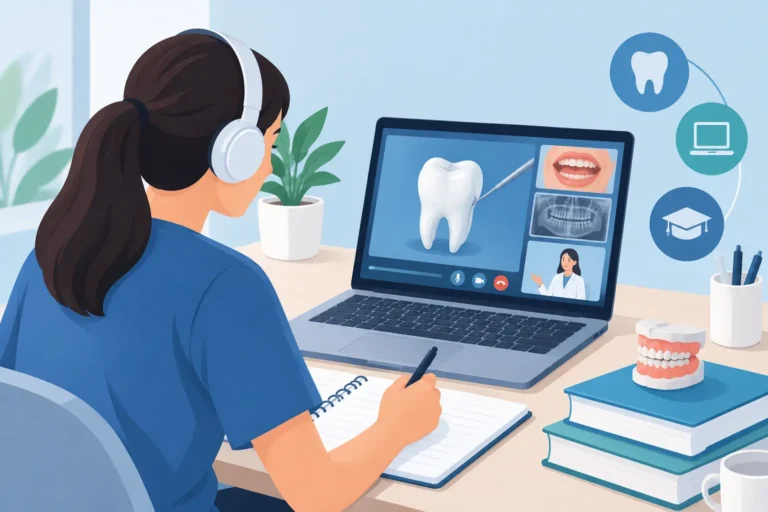
Virtual dental education for internationally trained dentists: learn U.S. bench standards, submit work for faculty review, and improve with purpose...
-
-
October 24, 2026

Are virtual bench courses effective? Learn how faculty feedback, rubric-based practice, and resubmission build U.S. dental bench exam readiness today.
-
-
October 22, 2026