
Are Virtual Bench Courses Effective for U.S. Exams?
A bench exam does not reward good intentions or broad clinical experience. It rewards a preparation that meets specific criteria under pressure: correct reduction, clean margins, appropriate taper, functional anatomy, surface quality, and time control. So, are virtual bench courses effective for internationally trained dentists? They can be, but only when the course recreates the feedback and revision process that turns a preparation into an exam-ready result.
Watching a video of a crown preparation is not the same as preparing a tooth, identifying your own errors, and receiving an evaluator’s explanation of what must change. The distinction matters. Virtual training is effective when it functions as a guided clinical skills system, not as a content library.
What Makes a Virtual Bench Course Effective?
The strongest virtual bench courses are built around performance, not passive viewing. They teach each procedure against a defined standard, ask candidates to produce work, and provide faculty-calibrated feedback that can be applied in the next attempt.
For U.S. dental school bench exams, that standard is especially important. Many internationally trained dentists have strong foundational skills and substantial clinical experience. The challenge is often not learning dentistry from the beginning. It is adapting established habits to the specific expectations used by U.S. evaluators.
A virtual course should therefore make the target visible. Candidates need to understand what appropriate occlusal clearance looks like, where a margin becomes too heavy or uneven, how convergence is judged, and why a preparation that appears acceptable at chairside may lose points in an exam setting. Clear demonstration videos provide a reference point, but evaluation is what reveals the gap between that reference and a candidate’s own work.
Why Feedback Determines Whether Online Training Works
Bench preparation is visual, tactile, and highly detailed. A candidate may believe a finish line is smooth until a faculty reviewer identifies lipping, inconsistent width, unsupported enamel, or an area that lacks definition. Without that outside review, the same error can become a repeated pattern.
Effective virtual training closes this loop. The candidate completes an assignment, submits clear documentation of the work, receives written evaluation, corrects the identified issues, and resubmits. Each cycle creates a more disciplined process: prepare, inspect, compare, correct, repeat.
This is where a faculty-led course has a meaningful advantage over generic online demonstrations. A video can explain ideal form. Personal review explains what is happening in your preparation and what should be changed first. That distinction helps candidates avoid wasting practice time on minor details while a higher-impact error remains unresolved.
The best feedback is also specific. “Improve your margins” is not enough. Useful evaluation identifies where the margin needs refinement, what instrument control may be causing the defect, how the issue affects the rubric, and what the next preparation should demonstrate. Candidates need direction they can execute at the bench.
Resubmission Builds Judgment, Not Just Repetition
More repetitions do not automatically create better results. If a dentist repeats a procedure without a clear standard or corrective plan, repetition may simply reinforce the same technique.
Resubmission changes the purpose of practice. Instead of completing ten unrelated preparations, the candidate works deliberately on a defined weakness. Perhaps the first submission reveals insufficient functional cusp reduction. The next attempt focuses on depth orientation, reduction control, and verification. That process develops the self-assessment skills needed when faculty are no longer present on exam day.
Over time, candidates learn to see their work through an evaluator’s perspective. They begin checking for the features that matter before submitting or moving to the next procedure. That is a major shift from practicing until something looks acceptable to practicing until the work meets a defensible standard.
Virtual Training Has Limits – and They Should Be Addressed
Virtual bench courses are not identical to in-person instruction. They cannot fully replace the immediate observation of hand position, bur angulation, posture, or pressure at the moment a mistake occurs. They also require the candidate to have consistent access to appropriate equipment, typodonts, materials, lighting, and a reliable way to capture high-quality images or videos of the work.
Motivation is another factor. In a classroom, scheduled sessions and peers create external accountability. In an asynchronous course, the candidate must establish a practice schedule and follow it. Professionals balancing work, family responsibilities, and licensure preparation may find this difficult without a structured plan.
These limitations do not make virtual training ineffective. They define what a candidate must evaluate before enrolling. A serious course should set clear submission requirements, provide a predictable feedback turnaround, organize assignments in a logical progression, and show candidates how each exercise connects to common bench exam criteria. When available, focused in-person training can complement online preparation by allowing candidates to test their work under realistic timing and evaluation conditions.
Are Virtual Bench Courses Effective for Different Skill Levels?
Effectiveness depends partly on the candidate’s starting point. A dentist who has not performed fixed prosthodontic preparations for years may need more foundational repetition before speed and refinement become realistic. A clinically experienced dentist may instead need to recalibrate technique for a rubric-driven exam environment.
For both groups, the virtual format can be valuable because it allows repeated review of demonstrations and flexible practice around a demanding schedule. However, flexibility should not mean lack of structure. Candidates need milestones: complete this procedure, submit by a target date, apply the feedback, then advance only when the essential criteria are under control.
Candidates who benefit most tend to approach virtual training as active preparation. They set up a dedicated practice area, follow the demonstrated sequence, document every assignment carefully, read feedback closely, and keep a record of recurring corrections. They do not assume completion of a lesson equals mastery of a procedure.
A candidate who only watches videos, practices occasionally, or submits work once without revisiting feedback is unlikely to gain the full benefit. The course provides the framework, but performance improves through consistent execution within that framework.
How to Evaluate a Virtual Bench Course Before You Enroll
Before choosing a course, look beyond the number of videos or total hours of content. Those details may be useful, but they do not show whether the program can improve your bench performance.
Ask whether the course includes direct faculty review of your actual work. Confirm how many submission and resubmission opportunities are included, whether feedback is written and rubric-based, and how quickly evaluations are returned. A candidate preparing for a high-stakes exam needs enough time to apply corrections, not merely receive a score after the fact.
Also examine whether the procedures and criteria are aligned with U.S. dental school expectations. Training should address the details evaluators look for: preparation design, margin quality, reduction, taper, finish, anatomy, and the ability to complete work within time limits. Broad restorative theory is valuable, but it is not a substitute for exam-specific preparation.
Finally, consider the instructor’s ability to explain standards clearly. Strong faculty do more than identify errors. They help candidates understand why an error matters and how to prevent it in future preparations. This creates confidence based on repeatable technique rather than guesswork.
Turn Online Instruction Into Exam-Ready Practice
Virtual training works best when each session has a purpose. Start by watching the relevant demonstration without rushing. Identify the sequence, instrument choices, checkpoints, and final evaluation criteria. Then complete the procedure under conditions that resemble the assignment requirements.
After submission, treat feedback as a clinical action plan. Review each comment beside your preparation. If possible, label the issue in your photos or write it in a practice log. Before beginning the next attempt, choose one or two primary corrections to prioritize. Trying to fix every possible detail at once can lead to rushed, inconsistent work.
As the exam approaches, add timing gradually. First establish correct form at a controlled pace. Then practice maintaining that form within the expected time. Speed without quality is not readiness, but quality that cannot be produced under time pressure is incomplete preparation.
Global Dental Elites Academy applies this model through faculty-led demonstrations, assignment submission, written evaluation, and structured resubmission cycles. The goal is not simply to show candidates what U.S. standards look like. It is to help them produce work that can stand up to those standards repeatedly.
A virtual bench course becomes effective when it asks more of you than watching and memorizing. Choose training that gives you a standard, requires evidence of performance, and provides expert correction. Then give the process the practice time it deserves. Confidence on exam day is built at the bench, one evaluated correction at a time.
You May Also Like

Understand foreign dentist eligibility for U.S. licensure, advanced standing programs, and bench exams with a focused, standards-based preparation plan.
-
-
October 26, 2026
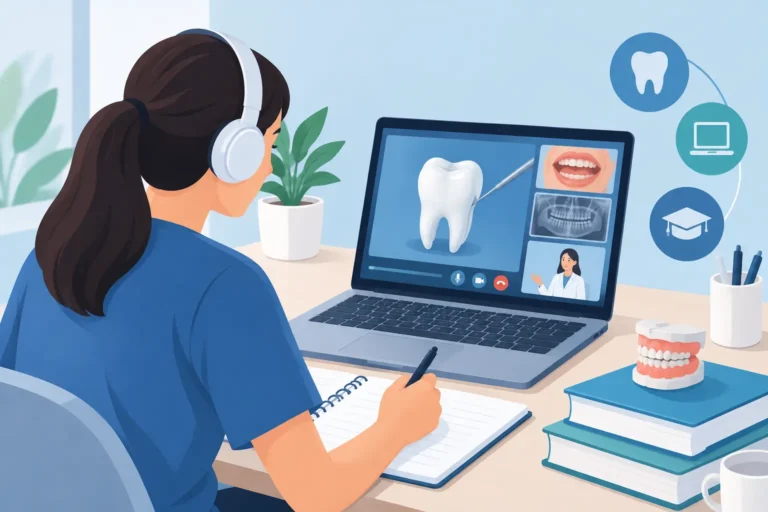
Virtual dental education for internationally trained dentists: learn U.S. bench standards, submit work for faculty review, and improve with purpose...
-
-
October 24, 2026

An in-person dental workshop gives internationally trained dentists faculty-guided practice, realistic grading, and real preparation for U.S. bench exams.
-
-
October 20, 2026