

Bench Exam Coaching Versus Self-Study
A handpiece, a typodont, and a timer can make you feel productive. That does not mean you are preparing the right way. For internationally trained dentists, bench exam coaching versus self study is not a simple question of discipline versus convenience. It is a question of calibration. Are you practicing in a way that matches how U.S. faculty will actually evaluate your work?
That distinction matters because most candidates are not starting from zero. They already have clinical experience, procedural knowledge, and years of education. The challenge is different. They must adapt their hand skills, preparations, finishing standards, and time management to a specific American exam environment where small deviations can carry large consequences.
Bench exam coaching versus self study: what really changes?
At the surface level, coaching gives you instruction and self-study gives you independence. In reality, the larger difference is feedback quality.
With self-study, you are responsible for selecting materials, interpreting criteria, judging your own work, and correcting mistakes before they become habits. If your understanding of reduction depth, outline form, taper, margins, or occlusal anatomy is slightly off, you may repeat that error dozens of times before recognizing it. Repetition alone does not improve performance. Accurate repetition does.
Coaching changes that process. A structured program gives you defined procedures, demonstration-based instruction, and direct evaluation against exam standards. Instead of asking, “Did I practice enough?” you can ask a better question: “Was my work acceptable by the standard that will be used on exam day?”
That shift is often what reduces uncertainty. Candidates do not only need more hours. They need more informed corrections.
When self-study works well
Self-study is not automatically a weak option. For some candidates, it can be efficient.
If you already understand the format of U.S. bench exams, have strong access to materials and equipment, know how to assess your own work honestly, and have prior exposure to exam-style grading, self-study can help maintain and sharpen your skills. It also offers scheduling flexibility. Many internationally trained dentists are balancing work, family obligations, immigration transitions, and financial pressure. Independent preparation can feel more practical because it lets you move at your own pace.
Self-study also suits candidates who are not in the earliest stage of preparation. If you have already received qualified feedback in the past and now need focused repetition, solo practice can be productive. In that setting, independence supports consistency.
But this path has a limit. Self-study works best when the candidate is already well calibrated. Without that, it can create false confidence.
Where self-study usually breaks down
The most common problem with self-study is not lack of effort. It is misjudgment.
Many candidates evaluate their own preparations based on general clinical acceptability, not exam acceptability. Those are not always the same. A preparation that might seem serviceable in one setting can still lose points under a strict bench rubric if wall form, convergence, finish lines, surface smoothness, or reduction uniformity do not meet expected criteria.
There is also the issue of blind spots. It is difficult to see your own technical habits while you are performing them. You may consistently over-reduce one surface, leave unsupported enamel, create inconsistent margins, or struggle with symmetry under time pressure. Without external review, these patterns can continue until they become deeply ingrained.
Then there is the matter of procedure selection. Not all practice is equally valuable. If you spend weeks on exercises that are only loosely related to actual bench expectations, you can invest substantial time without improving exam performance in a meaningful way.
For high-stakes admissions and licensure pathways, that is a costly gamble.
What coaching adds beyond information
Most candidates can find information. That is not the same as training.
Strong bench exam coaching gives you a defined performance system. It shows the target, breaks down the procedure, requires execution, and then measures your output against a known standard. That process is much closer to how technical skill actually improves.
The biggest advantage is faculty-calibrated feedback. When an experienced instructor reviews your work, the value is not limited to pointing out mistakes. The instructor can identify which errors are major, which are minor, which patterns will likely persist under stress, and what sequence of corrections will produce the fastest improvement. That level of guidance is difficult to reproduce on your own.
Coaching also improves efficiency. Instead of spending months guessing whether your crown prep or Class II exercise is competitive, you receive direct input on where you stand and what to fix next. That shortens the path between effort and progress.
For many internationally trained dentists, this is the difference between practicing hard and training correctly.
Bench exam coaching versus self study for international dentists
International dentists face a specific challenge that domestic candidates may not fully appreciate. Their skills are often strong, but the reference standard has shifted.
U.S. bench exams evaluate more than manual dexterity. They assess whether your procedural execution aligns with local academic expectations. That includes consistency, finish quality, time discipline, and adherence to grading details that may differ from how you were trained elsewhere.
This is why adaptation matters so much. A candidate may be clinically experienced and still underperform on a bench exam if they have not trained to the rubric being used. Coaching becomes especially valuable in this transition because it provides not just correction, but translation. It helps convert existing skill into exam-relevant performance.
That is also why passive video watching is not enough. Watching a procedure may improve understanding, but performance improves when your own work is reviewed and revised. The most effective coaching models create a feedback loop: demonstration, execution, submission, evaluation, correction, and resubmission. That loop builds consistency under standard-based expectations.
Cost, time, and risk: the trade-off most candidates miss
At first glance, self-study appears less expensive. In direct financial terms, that is often true. But exam preparation should be measured by total cost, not upfront cost.
If self-study leads to delayed readiness, repeated applications, weak bench performance, or missed admissions opportunities, the long-term cost can be much higher. Time has value. So does confidence. So does the ability to approach an exam with a clear understanding of where you stand.
Coaching requires investment, but it can reduce waste. It narrows your focus, gives structure to your schedule, and lowers the risk of spending months on low-yield practice. For busy professionals, that efficiency matters.
This does not mean every candidate needs the same level of coaching. Some need comprehensive feedback from the beginning. Others need targeted review after an independent practice phase. The right choice depends on your current skill level, your accuracy in self-assessment, your timeline, and the stakes of the exam you are preparing for.
How to choose the right path for your situation
If you are deciding between bench exam coaching versus self study, start by being precise about your weak point. Is the problem motivation, access to equipment, procedural understanding, calibration, or external accountability?
If you know exactly what high-quality work looks like, can reproduce it consistently, and have a trustworthy way to evaluate yourself, self-study may be enough for this stage. If you are unsure whether your work meets U.S. standards, or if you have practiced extensively without clear improvement, coaching is usually the stronger choice.
A practical middle ground often works well. Many candidates benefit from structured coaching early, when habits and standards are being set, and then use self-study to reinforce those corrections through repetition. That approach combines expert direction with independent volume.
This is where disciplined program design matters. A serious training model should not only provide content. It should create measurable progress through demonstration, assignment-based practice, timely faculty review, and clear expectations for revision. That is the difference between collecting resources and training with purpose. At Global Dental Elites Academy, that principle is central because the goal is not exposure to procedures. The goal is performance under U.S. exam standards.
Choosing your preparation method is not about proving that you can do everything alone. It is about selecting the path that gives you the clearest standard, the fastest correction cycle, and the strongest chance to perform when the result matters most. Train in a way that removes guesswork, because confidence on exam day should come from evidence, not hope.
You May Also Like

Use this international dentist admission pathway guide to plan credentialing, bench exams, applications, and feedback-led preparation for U.S. programs.
-
-
July 27, 2026
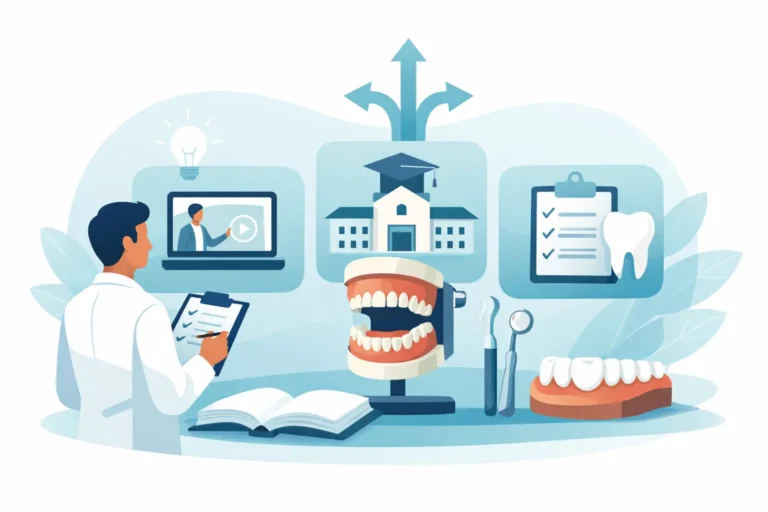
Use this bench exam course selection guide to compare feedback, curriculum, timing, and hands-on support before choosing U.S. dental training...
-
-
July 25, 2026

Learn what is bench exam evaluation, how U.S. dental schools score your work, and how targeted faculty feedback strengthens exam...
-
-
July 23, 2026