Online Versus Hands-On Training for Bench Exams
A bench exam can expose a gap that years of clinical experience do not always reveal: knowing how to perform a procedure is different from producing work that meets a specific rubric, within a limited time, under close evaluation. For internationally trained dentists, the decision between online versus hands-on training should begin with that distinction. The best format is not simply the one that feels most familiar. It is the one that helps you demonstrate controlled, repeatable performance at U.S. dental school standards.
What Online Versus Hands-On Training Really Means
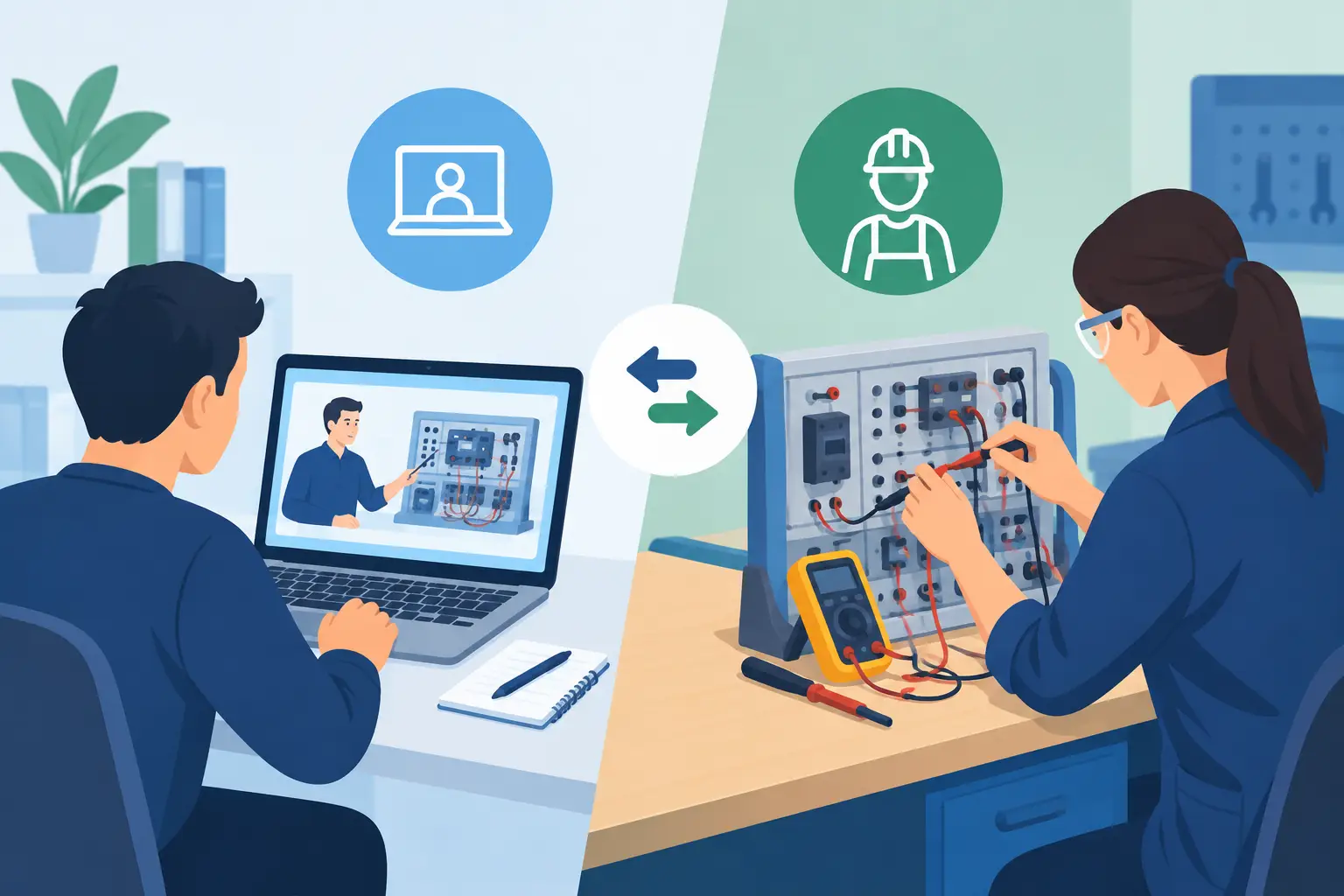
This is not a choice between theory and practice. High-quality online training can teach practical procedures through detailed faculty demonstrations, structured exercises, assignment submission, and individualized evaluation. Hands-on training can create the conditions of a live bench exam, where posture, time management, instrument control, preparation geometry, and decision-making are tested at once.
The real question is whether your training gives you a complete improvement cycle. You need to see the standard, attempt the procedure, receive calibrated feedback, correct the errors, and repeat the task. A course that only provides videos may improve your awareness, but awareness alone does not create a preparation that passes inspection. Likewise, a live session without enough time to review and repeat may identify weaknesses without giving you a reliable path to correct them.
For most candidates, online and hands-on formats serve different stages of preparation. They are most effective when used deliberately rather than treated as competing options.
Where Online Training Delivers Its Greatest Value
Online training is especially valuable when you need to build technique with consistency. Bench exam procedures are detail-dependent. A small deviation in taper, reduction depth, margin design, contact location, surface smoothness, or occlusal clearance can affect the final evaluation. The ability to pause a demonstration, review a sequence, and compare your work against a defined standard is a serious advantage.
A structured virtual program also allows you to practice on your own schedule. This matters for dentists balancing employment, family responsibilities, travel limitations, or preparation for multiple parts of an advanced standing application. Instead of trying to absorb every instruction during a single live session, you can return to a faculty demonstration before each attempt and focus on one correction at a time.
The strongest online option is not passive. It should require you to submit work for review and respond to feedback through resubmission. When a faculty member identifies an open contact, unsupported enamel, an incorrect path of insertion, or inadequate functional cusp reduction, you need more than a score. You need to know what to change in your next attempt and whether that change actually brought the work closer to exam expectations.
This feedback loop is where online training becomes more than content delivery. It becomes guided skill development. At Global Dental Elites Academy, this model is built around faculty-led demonstrations, assignment review, written evaluations, and defined resubmission opportunities so candidates can work toward measurable improvement rather than guess at their progress.
Online Training Is Best for Deliberate Repetition
Virtual learning is particularly effective during the phase when your goal is to make quality repeatable. You may understand the desired form after one demonstration, yet still produce inconsistent results across five preparations. Repetition helps convert observation into control.
Use online instruction to create a focused practice routine. Watch the procedure with a specific purpose, complete the task under similar conditions, photograph or document the result clearly, review faculty comments, and repeat the procedure with one or two defined corrections. This process is slower than simply moving from one exercise to the next, but it builds the discipline bench exams require.
Online training can also reduce wasted practice. Without calibrated feedback, candidates often repeat the same error many times. More hours at the bench do not help if the technique remains uncorrected. Precise evaluation gives every practice session a direction.
What Hands-On Training Adds That a Screen Cannot
Hands-on training brings the physical and psychological demands of a bench exam into focus. Even an excellent demonstration cannot fully reproduce the feeling of working at a station, managing unfamiliar equipment, receiving directions in real time, and completing a procedure before time expires.
Live training also allows direct evaluation of factors that are harder to assess remotely. Faculty can observe your finger rests, bur control, hand positioning, posture, preparation sequence, and approach to finishing. These details influence both the quality of the result and your ability to work efficiently under pressure.
For many internationally trained dentists, hands-on instruction is where U.S. exam expectations become tangible. You can compare your work beside calibrated examples, receive immediate clarification, and understand how seemingly minor deviations are viewed through a bench exam grading rubric. That experience can be especially valuable close to an exam date, when confidence must be based on performance rather than familiarity with the material.
Hands-On Training Is Best for Pressure Testing
A live environment is ideal when you have already developed a foundation and need to test whether it holds under realistic conditions. Can you complete the task within the allotted time? Can you recover after an imperfect initial cut? Can you maintain preparation design when fatigue and pressure increase?
These questions are difficult to answer through knowledge alone. A realistic hands-on session reveals whether your workflow is stable. It also exposes habits that may not appear during relaxed practice at home, such as overchecking, changing burs too frequently, rushing the finish line, or spending too much time correcting an error that should have been prevented earlier.
Hands-on training is not automatically better simply because it is in person. Its value depends on preparation. Candidates who attend before they understand the procedure may spend much of the session trying to follow basic steps. Candidates who arrive with repeated practice behind them can use live faculty access to refine higher-level issues: speed, precision, exam strategy, and performance under scrutiny.
Choose the Format Based on Your Current Gap
If you are unsure whether to begin online or hands-on, assess the source of your difficulty honestly. If you do not yet understand the expected preparation design, sequence, or grading criteria, start with structured online instruction. You need a clear technical standard before you can perform it consistently.
If you understand the procedure but your work varies from attempt to attempt, online submission and faculty feedback can help you isolate the pattern. Perhaps your margins are acceptable but your axial reduction lacks uniformity. Perhaps your outline form is correct but your proximal clearance is unreliable. Targeted review gives you a practical correction plan.
If your work is technically sound in practice but declines when time is limited, hands-on training may be the next step. That does not mean you should abandon online review. It means your primary gap has shifted from understanding to execution under exam conditions.
A blended approach is often the most efficient path. Build your foundation virtually, submit work for faculty evaluation, repeat until core requirements are stable, then use hands-on training to test performance in a realistic environment. Return to focused practice after the live session if new weaknesses appear. This sequence turns feedback into improvement rather than a one-time experience.
Avoid Two Common Preparation Mistakes
The first mistake is collecting information without producing enough evaluated work. Watching multiple preparation videos can make a procedure look familiar, but familiarity is not the same as competency. Your readiness should be measured by the quality and consistency of your own submitted exercises.
The second mistake is relying on self-evaluation alone. Experienced dentists have strong clinical instincts, but bench exams reward specific criteria that may differ from daily practice in another country or setting. U.S. dental school evaluators may assess details with a level of standardization that requires deliberate adaptation. Faculty-calibrated feedback helps close that gap.
Your goal is not to copy another person’s hand skills. It is to develop a repeatable method that produces results within the rubric. That requires objective standards, honest review, and enough repetitions to make corrections durable.
Train for Evidence, Not Just Confidence
Confidence is useful on exam day, but it should come from evidence. Evidence means you have completed procedures repeatedly, received expert feedback, corrected documented weaknesses, and performed under conditions that resemble the pressure you will face.
Choose online training when you need structure, repeatable review, and time to build the technical foundation. Choose hands-on training when you need direct observation, immediate coaching, and a realistic test of your execution. Use both when your goal is not merely to feel prepared, but to show measurable readiness at the bench.
The next preparation you complete should have a clear purpose: identify one criterion, meet it consistently, and let expert evaluation confirm that your work is moving toward the standard you will be asked to demonstrate.
You May Also Like

Understand foreign dentist eligibility for U.S. licensure, advanced standing programs, and bench exams with a focused, standards-based preparation plan.
-
-
October 26, 2026
Virtual dental education for internationally trained dentists: learn U.S. bench standards, submit work for faculty review, and improve with purpose...
-
-
October 24, 2026

Are virtual bench courses effective? Learn how faculty feedback, rubric-based practice, and resubmission build U.S. dental bench exam readiness today.
-
-
October 22, 2026