
In-Person Dental Workshop: Train for the Bench
A bench exam does not reward effort alone. It rewards controlled preparation, precise execution, and the ability to produce work that meets a defined standard under time pressure. An in-person dental workshop gives internationally trained dentists the opportunity to test those skills in a setting where small errors can be identified before they appear on exam day.
For candidates pursuing advanced standing admission or U.S. licensure pathways, hands-on training is not simply a chance to practice more. It is a chance to practice correctly, receive calibrated evaluation, and understand what separates an acceptable preparation from a competitive one.
Why Bench Skills Need In-Person Evaluation
Many internationally trained dentists have substantial clinical experience. They may have treated patients independently for years, restored complex cases, and developed strong hand skills. Yet bench exams measure performance through a specific U.S. grading lens. The challenge is rarely a lack of dental knowledge. It is adapting clinical judgment and hand movements to a narrow set of measurable criteria.
A preparation may look satisfactory at first glance but still lose points for insufficient occlusal reduction, unsupported enamel, an uneven finish line, excessive taper, poor proximal clearance, or an incorrect margin design. These details are difficult to judge consistently when practicing alone.
Faculty observation changes the learning process. Instead of asking, “Does this look good?” candidates learn to ask more useful questions: Is the reduction uniform? Is the path of insertion appropriate? Are the line angles smooth? Does this preparation meet the rubric rather than merely resemble a crown preparation?
That distinction matters. Bench exams are standardized assessments, and standardization requires candidates to work from objective criteria rather than personal impressions.
What an In-Person Dental Workshop Should Provide
Not every hands-on course offers the same value. A productive workshop must be built around exam performance, not general continuing education. Candidates should expect a structured environment with realistic exercises, direct faculty involvement, and evaluation tied to the standards they will face during admissions or licensing-related assessments.
Realistic Exam Conditions
Working at a bench under controlled timing reveals issues that are easy to miss during casual practice. Candidates see how their preparation sequence holds up when time is limited, visibility is imperfect, and each procedural decision must be made efficiently.
This does not mean every practice session should feel like a high-pressure test. Early practice should allow time to correct technique and understand the reason behind each adjustment. As skills improve, timed exercises become more valuable. The goal is to make efficient execution repeatable without sacrificing quality.
Direct Faculty Evaluation
Feedback has value only when it is specific enough to guide the next attempt. “Improve your margins” is not a complete correction. Effective feedback identifies the issue, explains how it affects grading, and directs the candidate toward a practical solution.
For example, faculty may point out that a margin is too irregular in a specific area, that axial walls require better convergence, or that an isthmus width is outside the required range. This level of detail helps candidates correct the actual cause of lost points rather than making broad, unfocused changes.
Direct evaluation also helps calibrate self-assessment. Over time, candidates begin to recognize defects before submitting their work. That is a critical step toward independent performance on exam day.
Repetition With Purpose
Repeating the same exercise is useful only when the next attempt is informed by evaluation. A workshop should not become a race to complete more teeth. It should provide a cycle of preparation, review, correction, and re-preparation.
This is where focused repetition becomes more effective than random practice. If proximal clearance is consistently inadequate, the candidate needs to understand bur position, access, viewing angle, and verification methods. If the issue is over-reduction, the correction may involve depth-cut control and a more disciplined reduction sequence. Each problem requires a different response.
How to Prepare Before Attending
An in-person training session delivers the greatest return when candidates arrive with a baseline understanding of the procedures. The workshop time should be used to refine execution, not to spend the first hours learning basic terminology or instrument selection.
Begin by reviewing the expected criteria for each exercise. Know the required reduction, taper, margin configuration, dimensions, and finish expectations. If your target exam uses typodont-based procedures, practice on similar materials whenever possible so the tactile experience is familiar.
It is also useful to document your current performance before attending. Take clear photographs of several preparations and identify recurring concerns. Perhaps your margins lack consistency, your occlusal anatomy becomes flattened, or your preparations take too long to complete. Entering the workshop with these observations gives faculty feedback a clearer starting point.
Candidates should also build endurance. Bench exams demand sustained concentration and fine motor control. Completing one strong preparation is different from maintaining accuracy across multiple exercises. Practice sessions that gradually increase in duration can expose fatigue-related errors before they become a problem.
What to Focus On During Hands-On Training
During an in-person dental workshop, avoid treating feedback as a pass-or-fail judgment. The purpose is to expose weaknesses while there is still time to correct them. Candidates who improve fastest are usually those who remain methodical after receiving criticism.
Focus first on the criteria that most directly affect the score. Measurements, clearance, margin integrity, wall form, and finish quality often matter more than cosmetic appearance. A preparation can appear smooth but fail because it does not meet the required dimensions. Conversely, a technically correct preparation may need only finishing refinements to become stronger.
Ask for clarification when a correction is not fully understood. You should leave each faculty review knowing what to change, why it matters, and how to verify the correction on your next attempt. That may involve using a reduction guide, changing your bur orientation, modifying your sequence, or checking the work from a different angle.
It also helps to compare your work against the rubric before faculty review. This develops the habit of objective inspection. Check the preparation systematically rather than relying on a quick visual impression: occlusal reduction, axial reduction, taper, margins, clearance, surface smoothness, and overall form. A consistent review sequence reduces the chance of overlooking a critical defect.
Combining Virtual Learning and Hands-On Practice
For many candidates, the strongest preparation model combines structured virtual instruction with limited, purposeful in-person training. Virtual lessons allow repeated review of demonstrations, procedural sequences, and grading concepts at a pace that fits a working professional’s schedule. In-person sessions then test whether that knowledge translates into accurate hand skills.
The trade-off is that neither format replaces the other. Online training alone may not reveal tactile or ergonomic mistakes. In-person practice without a clear instructional framework can become expensive trial and error. Candidates benefit most when demonstrations, assignments, personal feedback, and live practice reinforce the same exam criteria.
Global Dental Elites Academy applies this approach by pairing exam-focused virtual training and faculty review with limited-seat hands-on training in Houston, Texas. The emphasis is not simply on completing exercises. It is on producing work that can be evaluated against U.S. dental standards and improved through a defined feedback cycle.
Choosing the Right Time for a Workshop
The best time to attend depends on your current level of preparation and exam timeline. Candidates who attend too early may benefit from foundational exposure, but they may not yet have enough practice experience to apply detailed feedback efficiently. Candidates who wait until the final days before an exam may discover major gaps without enough time to correct them.
A practical window is after you have completed foundational instruction and performed enough independent practice to identify patterns in your work. At that stage, faculty evaluation can help you correct habits before they become fixed. You still need time afterward to repeat the corrected technique until it feels reliable.
If your exam is approaching quickly, prioritize the procedures with the greatest scoring impact and the areas where your performance is least consistent. Perfection across every possible exercise may not be realistic. A disciplined plan that targets measurable weaknesses is usually more productive.
Turn Feedback Into Exam-Day Confidence
Confidence is not created by telling yourself that you are ready. It comes from evidence: you understand the grading criteria, you have practiced under realistic conditions, you have received expert evaluation, and you have corrected the same errors more than once.
An in-person workshop gives candidates a valuable checkpoint in that process. It makes performance visible. It replaces uncertainty with specific corrections and turns abstract exam standards into skills that can be repeated at the bench.
Use that experience as a standard for the practice that follows. Each preparation completed after the workshop should reflect a deliberate decision to measure, inspect, correct, and improve. That is how technical ability becomes dependable performance when it matters most.
You May Also Like

Understand foreign dentist eligibility for U.S. licensure, advanced standing programs, and bench exams with a focused, standards-based preparation plan.
-
-
October 26, 2026
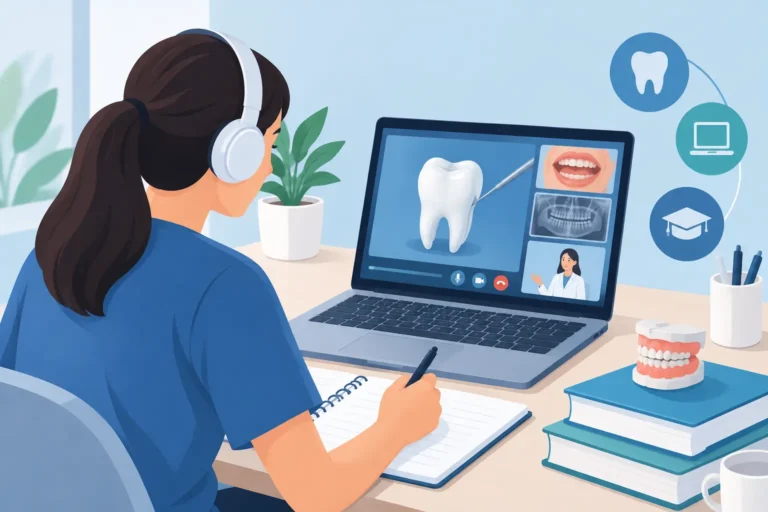
Virtual dental education for internationally trained dentists: learn U.S. bench standards, submit work for faculty review, and improve with purpose...
-
-
October 24, 2026

Are virtual bench courses effective? Learn how faculty feedback, rubric-based practice, and resubmission build U.S. dental bench exam readiness today.
-
-
October 22, 2026