
Advanced Standing Application Guide for Dentists
A strong advanced standing application guide starts with one reality: admission committees are not only evaluating whether you earned a dental degree abroad. They are evaluating whether you can transition successfully into a U.S. dental school environment, meet clinical expectations, and perform under a standardized admissions process.
For internationally trained dentists, the application is a professional case for readiness. Every document, score, essay, recommendation, and bench test interaction should support the same message: you have the foundation, discipline, and adaptability to succeed in advanced standing training.
Start With a Program-by-Program Strategy
Advanced standing programs may share common requirements, but they do not assess applicants in exactly the same way. One school may place significant weight on academic history and English-language proficiency. Another may use the bench exam and interview to distinguish candidates with similar credentials. Some accept applications through a centralized service, while others require supplemental materials, separate fees, or additional documentation.
Do not treat the process as a single application copied across every school. Build a tracking system for each program that includes deadlines, required evaluations, English test requirements, application platform, supplemental forms, recommendation requirements, bench exam format, interview format, and tuition or deposit timelines.
This level of organization protects you from a common and costly mistake: submitting a technically complete application that does not meet a program’s specific instructions. A missed supplemental question or delayed credential evaluation can remove a qualified applicant from consideration before the admissions committee has reviewed clinical potential.
Know What Each Requirement Is Designed to Measure
Application requirements are not random administrative steps. Credential evaluations help programs understand your academic history in a U.S. context. English-language scores help confirm that you can learn, communicate, and participate in patient-centered education. Personal statements reveal motivation and professional judgment. Recommendations provide outside evidence of your work ethic and character.
The bench exam, when required, addresses another question: can you produce work that meets the program’s clinical standards under time limits and direct evaluation? Your preparation should match the purpose of each component.
Build Your File Before the Deadline Pressure Begins
Many internationally trained dentists underestimate how long it takes to collect and verify documents. University transcripts, degree certificates, course records, translations, credential evaluations, test scores, and recommendation letters can involve multiple institutions and several weeks of processing.
Start by creating a secure digital folder with clearly labeled files. Keep original-language documents, certified translations, official evaluations, score reports, passport identification, and updated curriculum vitae in one place. Use consistent naming so you can immediately identify the correct version when a program asks for a resubmission.
Your curriculum vitae should be concise, accurate, and easy to review. Include dental education, clinical practice, internships, postgraduate training, research, teaching, volunteer work, certifications, and relevant continuing education. Do not inflate responsibilities or list procedures you cannot discuss confidently in an interview.
Admissions committees understand that international applicants come from different systems. They are not expecting identical experiences. They are looking for clarity, professionalism, and evidence that you have maintained clinical engagement and continued to develop as a dentist.
Write a Personal Statement With Evidence, Not General Claims
A personal statement should not read like a biography or a list of obstacles. It should explain your professional direction with focus. Why are you pursuing advanced standing? What have you learned through your previous training and clinical experience? Why is U.S. dental education the right next step? How will you use that training to serve patients and build a responsible career?
Strong statements use specific examples. Rather than writing that you are passionate about dentistry, describe a moment in clinical practice, patient care, public health service, teaching, or professional growth that shaped your goals. Rather than claiming you are hardworking, show the actions you took to continue improving after graduation.
Keep the tone mature and forward-looking. You may acknowledge challenges, especially if they explain a gap or major transition, but avoid making the statement entirely about hardship. Your goal is to demonstrate resilience while keeping the focus on clinical purpose, academic readiness, and future contribution.
Before submitting, check for clear organization, grammar, and consistency with the rest of your application. If your statement describes a commitment to advanced clinical standards, your CV, recommendations, and interview should reinforce that commitment.
Choose Recommenders Who Can Evaluate Your Performance
A generic recommendation letter offers little value. Select recommenders who have directly observed your work and can speak with detail about your clinical ability, professionalism, ethics, communication, academic performance, or leadership.
For many applicants, the best combination includes a former faculty member, a clinical supervisor, or a dentist who has worked closely with you. The right choice depends on your background and the program’s instructions. A respected person who barely knows you is usually less helpful than a supervisor who can provide specific examples of your judgment, reliability, and commitment to improvement.
Give recommenders adequate notice and provide them with your CV, personal statement themes, deadlines, and any program-specific instructions. This is not about telling them what to write. It is about helping them write an accurate, informed letter that reflects your current goals.
Treat the Bench Exam as a Separate Performance Project
For programs that require a bench exam, application strength alone will not be enough. Bench testing is where many capable dentists face a difficult adjustment. The challenge is not simply knowing how to prepare a tooth or complete a restorative procedure. It is producing a controlled result that meets a specific rubric within a limited time.
U.S. bench exams commonly assess details such as reduction depth, taper, margin design, occlusal clearance, smoothness, preservation of adjacent structures, proximal contacts, and overall finish. A preparation that is clinically acceptable in another setting may still lose points if it does not meet the program’s prescribed criteria.
The most effective preparation is deliberate and measurable. Study the expected design, watch calibrated demonstrations, practice under timed conditions, compare your work against a rubric, and obtain feedback from faculty who understand how exam work is graded. Repetition without evaluation can reinforce the same technical errors.
At Global Dental Elites Academy, the training model is built around this principle: perform the procedure, submit your work, receive faculty evaluation, correct the errors, and resubmit with greater control. For applicants preparing for high-stakes bench exams, that feedback loop is often more valuable than simply completing more practice sessions.
Practice Under Conditions That Reveal Weaknesses
Untimed practice has a role early in preparation, when you are learning sequence and hand skills. But it cannot be your only method. As the exam approaches, simulate the actual pressure: use the expected materials when possible, set strict time limits, work without interruptions, and inspect your result using measurable criteria.
Photograph or scan your preparations if your training setup allows it. Compare early attempts with later work. Look for recurring patterns such as insufficient clearance, rough internal surfaces, uneven margins, over-tapered walls, or poor transition angles. Improvement becomes faster when you identify the pattern instead of reacting to every attempt as an isolated result.
Prepare for Interviews With Professional Precision
An admissions interview is not a test of memorized answers. It is an opportunity for the school to assess communication, professionalism, self-awareness, and alignment with its program. Be prepared to discuss your dental education, clinical experiences, reasons for pursuing advanced standing, understanding of U.S. dental practice, and plans after graduation.
Expect questions about gaps in your timeline, changes in career direction, prior exam attempts, or areas where you needed to improve. Answer directly without becoming defensive. A mature response explains what happened, what you learned, and what you have done differently since then.
You should also be ready to discuss ethics and patient care. Programs want students who understand that technical skill is only one part of professional dentistry. Clear communication, informed consent, cultural awareness, teamwork, and accountability matter throughout dental school and clinical practice.
Avoid Common Application Errors
The most damaging mistakes are often preventable. Rushing documents, using a generic personal statement, asking for recommendations at the last minute, and delaying bench preparation can weaken an otherwise competitive profile. Another frequent problem is applying without understanding the financial and time commitment required after admission.
Be honest about your readiness. If your English scores, academic record, or bench skills need improvement, a strategic delay may be stronger than submitting an application before you can perform at your best. Timing depends on your target programs, finances, visa situation, and current preparation level. There is no advantage in applying early if the application does not represent your highest standard.
Approach every stage with the discipline expected of a future U.S.-trained dentist. A well-prepared application does more than earn an interview. It gives you a clear standard to work toward, so that when the bench exam or admissions conversation arrives, you can present your skills with confidence and control.
You May Also Like

Understand foreign dentist eligibility for U.S. licensure, advanced standing programs, and bench exams with a focused, standards-based preparation plan.
-
-
October 26, 2026
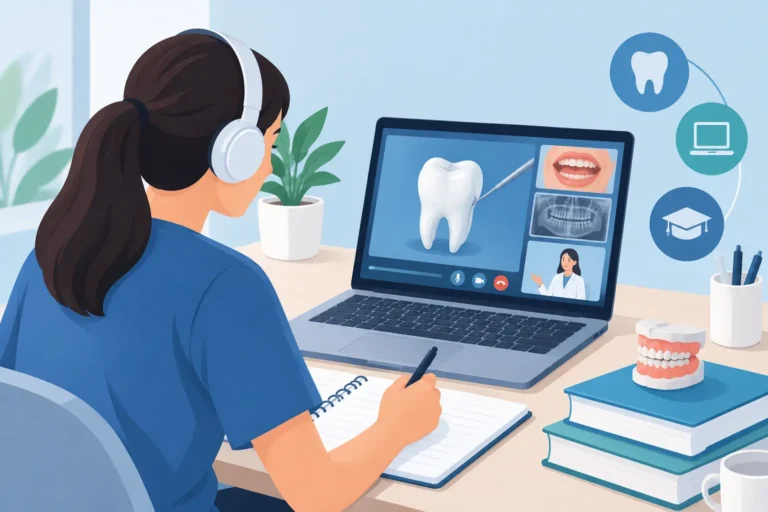
Virtual dental education for internationally trained dentists: learn U.S. bench standards, submit work for faculty review, and improve with purpose...
-
-
October 24, 2026

Are virtual bench courses effective? Learn how faculty feedback, rubric-based practice, and resubmission build U.S. dental bench exam readiness today.
-
-
October 22, 2026