
International Dentist Admission Pathway Guide
A strong international dentist admission pathway guide begins with a reality that many candidates learn late: clinical experience alone does not guarantee advanced standing admission. U.S. dental schools assess how accurately you can perform within their standards, follow instructions under pressure, document your qualifications, and communicate your readiness as a future student and clinician.
For internationally trained dentists, the pathway is demanding because several high-stakes requirements converge at once. You may need to manage credential evaluation, English-language testing, centralized applications, school-specific requirements, bench exams, interviews, and financial planning while continuing to work or support a family. The most effective approach is not to treat these as separate tasks. Build one disciplined plan in which each stage strengthens the next.
Understand What You Are Applying For
Most international dentists seeking U.S. licensure pursue an advanced standing or international dentist program. These programs allow eligible dentists educated outside the United States or Canada to complete a shortened predoctoral dental curriculum, often leading to a DDS or DMD degree. Graduation then creates eligibility to pursue the licensure requirements of the state where you intend to practice.
Admission is competitive because programs have limited seats and applicants commonly bring years of clinical experience. Schools are not simply selecting the person with the longest résumé. They want evidence that you can adapt to U.S. clinical protocols, patient-safety expectations, academic systems, and assessment criteria.
That distinction changes how you should prepare. A detailed work history may support your application, but it cannot replace a precise bench preparation record. Likewise, an excellent test score may earn attention, but it will not compensate for a preparation that fails a school’s specified dimensions, margins, taper, reduction, finish line, or procedural sequence.
Build Your International Dentist Admission Pathway
Your timeline should start well before application season. Some documents take months to obtain, correct, translate, or evaluate. Bench skills also need repeated practice cycles, not a short review immediately before an invitation.
Confirm school eligibility before spending heavily
Every program sets its own requirements. Review each school’s admissions materials closely and create a comparison sheet for prerequisites, accepted credential evaluators, English-language test minimums, required examinations, application platform, recommendation letters, bench exam format, interview process, tuition, and deadlines.
Do not assume that a requirement accepted by one school will satisfy another. Programs may differ in the number of accepted international applicants, whether they require recent clinical experience, which English tests they recognize, and the type of practical assessment used. State licensure rules can also differ after graduation, so your target programs should align with the state where you may eventually practice.
This research prevents a common mistake: applying broadly without a clear fit. A focused list of programs where you meet the published criteria is usually more strategic than submitting rushed applications to schools with incompatible requirements.
Organize your credentials early
Credential evaluation verifies your foreign dental education for U.S. admissions purposes. The process often requires official academic records, degree certificates, translations where applicable, and direct delivery from your university. Missing seals, name discrepancies, or incomplete transcripts can cause delays that affect an entire admission cycle.
Use one consistent legal name across your passport, test registrations, evaluations, application, and supporting documents whenever possible. If your records contain a different spelling, married name, or order of names, prepare the official documentation needed to explain the discrepancy. Small administrative inconsistencies can become significant when deadlines are fixed.
You should also prepare a current curriculum vitae and a clear record of clinical employment, continuing education, volunteer service, research, and leadership. The goal is not to overload the application with every activity. Select experiences that demonstrate professional maturity, ethical judgment, sustained commitment to dentistry, and preparation for transition into a U.S. program.
Treat English-language testing as an admission requirement, not a formality
For many applicants, English testing is a required component of the file. Strong performance matters because advanced standing programs move quickly through complex lectures, patient interactions, treatment planning, documentation, and clinical evaluations.
Prepare for the test format with the same discipline you bring to clinical training. Set a target score above the minimum when realistic, allow enough time for a retake if needed, and verify score-reporting rules for every school. A score that arrives after a deadline may not be useful, even if it is excellent.
Make the Application Evidence-Based
A competitive application tells a coherent story: you are an educated dentist, you understand why further U.S. training is necessary, and you have taken measurable steps to meet the standard. Your personal statement should support that story with specific examples rather than broad claims about passion or ambition.
Explain your clinical background and the professional transition you seek. If you have encountered a gap between prior training and U.S. expectations, describe how you addressed it through education, observation, structured practice, or mentorship. The strongest statements show reflection and accountability. They do not blame circumstances or rely on dramatic language.
Letters of recommendation should come from people who can speak directly about your clinical judgment, work ethic, technical discipline, communication, and capacity to learn. Give recommenders adequate time and provide them with the information they need to write a meaningful letter. A generic endorsement carries less weight than a specific assessment from someone who has observed your work.
Submit early whenever the application process allows it. Early submission does not guarantee an interview, but it gives programs more time to review a complete file and reduces the risk that a preventable document delay harms your chances.
Prepare for the Bench Exam Like a Calibrated Assessment
The bench exam is often the point where qualified applicants are separated by execution. It is not a general test of whether you have practiced dentistry. It is a timed, rubric-based evaluation of whether your work meets a school’s expected standard under controlled conditions.
Candidates can lose points despite a visually acceptable result when they miss objective criteria. Common issues include inadequate or excessive reduction, poor draw, unsupported enamel, irregular finish lines, damaged adjacent structures, failure to follow instructions, and weak time management. A candidate may understand the procedure conceptually yet still underperform if their hand skills have not been calibrated to the evaluation rubric.
Practice should therefore be deliberate. Start by learning the target preparation design and instrumentation sequence. Then complete timed repetitions under exam-like conditions. Photograph or scan your work when possible, compare it against stated criteria, identify one or two high-impact errors, and repeat the exercise with a defined correction goal.
Passive viewing has limits. Watching an ideal preparation can clarify technique, but it does not reveal whether your own work meets the standard. You need direct evaluation from someone who can identify why a margin is inconsistent, why a wall lacks appropriate taper, or why your reduction does not satisfy the required measurement.
Global Dental Elites Academy uses this feedback-driven model through faculty demonstration, assignment submission, written evaluation, and structured resubmission. For candidates who need to translate established clinical experience into bench exam performance, that review cycle creates a clearer path than practicing alone and guessing at the standard.
Train your timing, not only your technique
A bench exam rewards controlled execution within a fixed time. Some candidates spend too long chasing a minor imperfection and leave insufficient time for verification or completion. Others rush early steps and create errors that require more time to repair.
Use a timed workflow for each exercise: assess the typodont, establish the initial reduction, create the preparation form, refine margins and surfaces, then inspect against the rubric. As your technique improves, track where time is lost. Your goal is not to work frantically. It is to make the procedure repeatable.
Approach Interviews With the Same Preparation Standard
An interview may assess professionalism, communication, motivation, cultural awareness, ethical reasoning, and your ability to contribute to a dental school community. Schools may also ask about your prior education, clinical decisions, gaps in your timeline, and reasons for choosing their program.
Prepare concise, honest answers grounded in experience. Practice explaining why you are pursuing advanced standing training without minimizing your previous education or overstating your readiness. You can be confident and still acknowledge the value of learning U.S. standards, systems, and clinical protocols.
Be ready to discuss patient-centered care. Admissions committees want dentists who can listen, communicate across differences, accept feedback, and make safe decisions. Technical skill matters, but professional behavior is part of the clinical standard.
Plan for the Variables You Cannot Control
Admission timelines can change. A school may alter a deadline, invite more applicants than expected, update its assessment format, or place you on a waitlist. Your response should be organized rather than reactive.
Maintain a document calendar, keep test scores and evaluations current, and continue improving your clinical portfolio while you wait. If you are not admitted in one cycle, request feedback when schools provide it, review each part of your preparation honestly, and strengthen the area with the greatest effect on your result. Reapplying with the same application and the same bench performance rarely changes the outcome.
Financial planning deserves the same attention. Application fees, evaluations, testing, travel, bench preparation, tuition, and living expenses add up quickly. Create a realistic budget before committing to a broad strategy. The right pathway is not always the fastest one. It is the one you can complete with sufficient preparation and sustained focus.
Your previous dental degree is the foundation of this process, not the finish line. Build a file that is accurate, practice to the rubric, seek calibrated feedback, and give your preparation enough time to become consistent. That is how you enter the admissions process ready to demonstrate more than experience – ready to meet the standard.
You May Also Like

Understand foreign dentist eligibility for U.S. licensure, advanced standing programs, and bench exams with a focused, standards-based preparation plan.
-
-
October 26, 2026
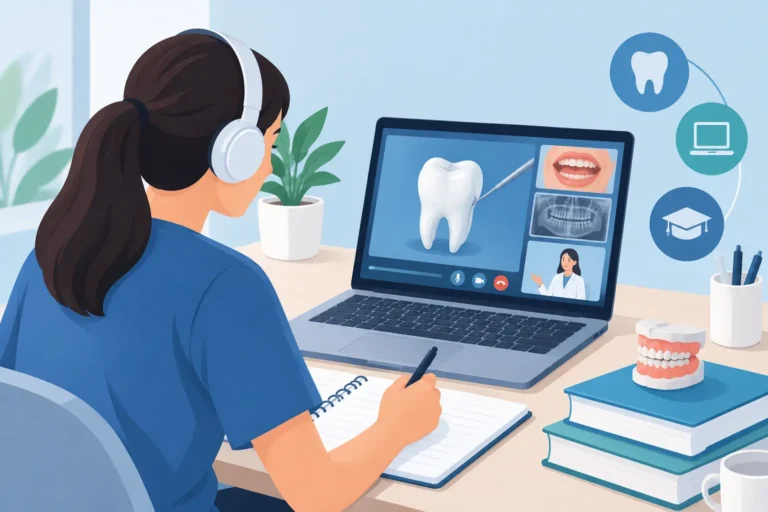
Virtual dental education for internationally trained dentists: learn U.S. bench standards, submit work for faculty review, and improve with purpose...
-
-
October 24, 2026

Are virtual bench courses effective? Learn how faculty feedback, rubric-based practice, and resubmission build U.S. dental bench exam readiness today.
-
-
October 22, 2026