

Bench Exam Assignment Review Process Explained
A bench exam submission can feel deceptively simple. You prepare the tooth, take the photos, upload the assignment, and wait. But the real value is not in the upload itself. It is in the bench exam assignment review process – the point where practice becomes measurable, gaps become visible, and improvement becomes intentional.
For internationally trained dentists, that process matters because U.S. bench exams do not reward general competence alone. They reward precision under a specific standard. A preparation that looks acceptable in one system may lose points in another if reduction depth, finish line design, wall taper, margins, or overall form do not match the evaluator’s expectations. That is why a serious review process must do more than say whether a preparation looks good. It must show whether it meets exam criteria.
Why the bench exam assignment review process matters
Many candidates spend months practicing procedures without a calibrated external review. That often creates a false sense of readiness. The work may improve in speed or consistency, but not in the exact areas that matter on exam day. A structured bench exam assignment review process closes that gap by connecting each submission to defined performance standards.
This is especially important when you are adapting to U.S. dental school expectations. The challenge is not just technical execution. It is learning how your work will be judged. Review helps you understand where your preparation is over-reduced, under-reduced, asymmetrical, unsupported, rough, or simply inconsistent with the exam rubric. Without that correction, repetition can reinforce mistakes instead of fixing them.
A disciplined review cycle also reduces ambiguity. Candidates often ask whether a preparation is “passable.” That is usually the wrong question. A stronger question is whether the work is predictable, rubric-aligned, and repeatable under pressure. Review moves your training toward that level.
What reviewers should actually assess
A credible review process is not based on general encouragement. It is based on observable criteria. In bench exam preparation, reviewers should assess the same technical areas that can influence scoring in a live evaluation.
Reduction and form
Reduction is one of the most common problem areas because small deviations can change the entire preparation. Review should look at incisal or occlusal reduction, axial reduction, functional cusp bevel when relevant, and overall preservation of proper anatomy. The issue is not only whether enough tooth structure was removed, but whether it was removed in the right place and in the right pattern.
Form matters just as much. Total convergence, wall height, path of draw, resistance form, and smoothness all affect how the preparation reads to an evaluator. Some candidates prepare aggressively to avoid under-reduction, then create other problems with retention or contour. Others preserve too much and compromise clearance. A strong reviewer identifies the trade-off, not just the defect.
Margin quality and finish lines
Finish lines are frequently the difference between average work and exam-ready work. Review should examine margin continuity, depth, location, smoothness, and consistency around the entire preparation. A margin that appears acceptable from one angle may reveal irregularity from another. That is why image quality and viewing angles are part of the process, not an afterthought.
Surface refinement and procedural discipline
Bench exams often expose habits. Rough walls, unsupported enamel, vague line angles, and inconsistent rounding usually reflect a process issue, not just a one-time error. Good review identifies those habits. It helps you see whether the problem starts with bur control, visualization, sequence, hand positioning, or failure to verify dimensions before moving forward.
How a strong review process should work
The best systems are structured, repeatable, and time-bound. Candidates need more than comments. They need a training loop.
A sound process begins after the learner studies the assigned procedure and completes the exercise according to the required standard. The first checkpoint is submission quality. If photos are unclear, poorly angled, or incomplete, even a skilled reviewer cannot evaluate accurately. Serious programs teach candidates how to submit work in a way that supports precise feedback.
Next comes the faculty review itself. This stage should be detailed enough to identify both strengths and deficiencies, but focused enough that the learner knows what to fix first. Too little feedback leaves the candidate guessing. Too much undifferentiated feedback can overwhelm and slow progress. The strongest reviews prioritize corrections by impact.
Then comes the improvement phase, which many candidates underestimate. Review only becomes valuable when it leads to action. If a candidate receives feedback on taper, reduction, and margin continuity, the next attempt should be built around those points, not treated as a fresh unsupervised repetition. That is where structured resubmission becomes essential.
The role of resubmission in skill development
Resubmission is not a sign that you performed poorly. It is a core part of performance training. In fact, candidates who improve most consistently are usually those who engage seriously with revision rather than chasing constant new procedures before mastering the current one.
A well-designed review process uses resubmission to measure whether feedback has been understood and applied. This is a major difference between passive video learning and guided preparation. Watching a demonstration may show what a correct preparation looks like. Resubmitting your own work after expert correction shows whether you can produce it.
That distinction matters because exam success depends on execution, not recognition. Many candidates can identify a good typodont preparation when they see one. Fewer can reproduce it on demand, within time, while controlling every detail. Resubmission builds that control.
There is also a psychological advantage. Bench exam preparation can become emotionally draining when progress feels subjective. A review-resubmission cycle makes improvement visible. It turns anxiety into a sequence: perform, receive feedback, correct, repeat. That structure supports confidence because confidence grows from evidence, not optimism.
What candidates should do before submitting
The review process works best when the learner is disciplined before the upload. A rushed or careless submission wastes a feedback opportunity. Before sending an assignment, candidates should evaluate their own work against the expected criteria. That includes checking dimensions, inspecting margins, reviewing symmetry, and confirming that the preparation reflects the assigned design rather than what feels familiar from prior training.
It also helps to approach submission with a diagnostic mindset. Instead of asking only, “Is this done?” ask, “Where might this lose points?” That shift prepares you to receive feedback productively. It reduces defensiveness and improves your ability to translate comments into technical changes.
This is one reason faculty-led systems tend to produce stronger outcomes. When the reviewer is calibrated to exam expectations and the training platform is built around assignment review rather than content consumption alone, each submission becomes part of a deliberate performance pathway. That model is central to how Global Dental Elites Academy trains candidates to meet U.S. standards with greater precision and accountability.
Common mistakes in the bench exam assignment review process
Not every review process is equally useful. Some fail because the feedback is too vague. Comments like “improve taper” or “smooth the margins” are directionally correct, but they are not always enough. Candidates need specificity. Which wall? How much taper? Where is the margin irregular? What instrument or sequence change would help?
Another common issue is delayed review. Timing matters. When feedback comes too late, the learner may already be repeating the same mistake across multiple attempts. A defined turnaround supports momentum and keeps the correction connected to the original work.
There is also the problem of uncalibrated evaluation. Feedback from peers or non-specialized instructors can be encouraging, but if it is not aligned with bench exam scoring standards, it may not prepare you for the actual assessment environment. Support is helpful. Calibration is decisive.
How to judge whether a review system is helping you
A useful review system should make your work more consistent, more exam-specific, and easier to self-evaluate over time. You should notice that you are not only fixing isolated mistakes, but also developing sharper judgment. You begin to recognize problems earlier, plan your sequence more carefully, and make fewer corrections at the end.
Progress may not always feel linear. Some assignments expose weaknesses that were hidden before. That is normal. In high-stakes preparation, temporary frustration can be a sign that the training is becoming more precise. The key is whether feedback leads to measurable correction.
If your submissions are receiving clear evaluations, if resubmissions show improved alignment with the rubric, and if your independent practice is becoming more controlled, the process is doing its job. It is turning effort into exam readiness.
Bench exam preparation should never be reduced to practice alone. Practice matters, but unreviewed practice has limits. What changes performance is a disciplined system that identifies the right problems, corrects them clearly, and gives you the chance to prove improvement on the next attempt. That is how skills become reliable enough to carry into a U.S. bench exam with confidence.
You May Also Like

Use this international dentist admission pathway guide to plan credentialing, bench exams, applications, and feedback-led preparation for U.S. programs.
-
-
July 27, 2026
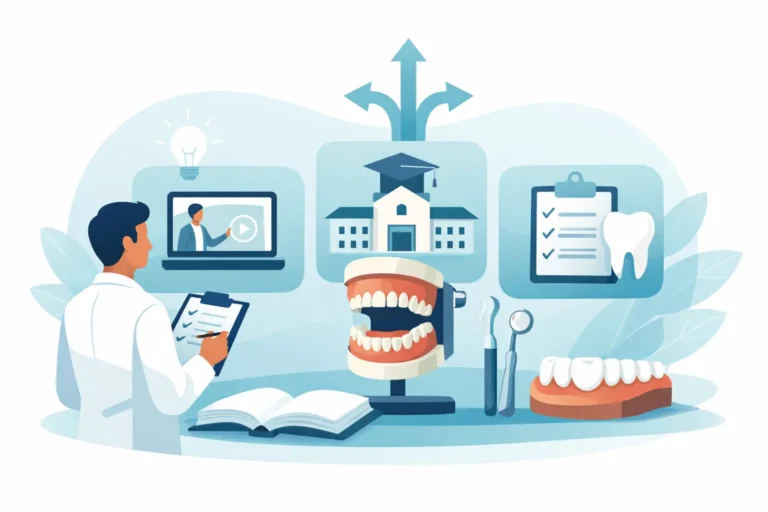
Use this bench exam course selection guide to compare feedback, curriculum, timing, and hands-on support before choosing U.S. dental training...
-
-
July 25, 2026

Learn what is bench exam evaluation, how U.S. dental schools score your work, and how targeted faculty feedback strengthens exam...
-
-
July 23, 2026