

Online vs In-Person Bench Training
If you have ever finished a prep, crown, or wax-up and wondered whether it would actually pass under U.S. bench exam criteria, you already understand the real issue behind online vs in-person bench training. The question is not which format feels more convenient. The question is which format helps you perform to standard when every margin, contour, and evaluation point matters.
For internationally trained dentists, this choice can shape both preparation quality and confidence. Many candidates already have strong clinical backgrounds, but bench exams in the United States are not testing experience in a broad sense. They are testing your ability to reproduce specific results under specific expectations, often within strict time limits and grading systems that may be unfamiliar. That is why the best training decision is rarely based on preference alone. It depends on your current skill level, your feedback needs, your timeline, and how close you are to exam day.
What online vs in-person bench training really means
This comparison is often framed too simply. Online training is sometimes treated like passive video learning, and in-person training is often assumed to be automatically superior because it is hands-on. In serious bench exam preparation, neither assumption is accurate.
High-quality online bench training should not be a video library you watch once and forget. It should be a guided system with clear demonstrations, faculty standards, assignment submission, personalized evaluation, and resubmission opportunities. When built correctly, online training allows candidates to practice repeatedly, compare their work against calibrated expectations, and improve through a structured feedback loop.
In-person bench training offers something different. It puts you in a controlled environment where posture, instrument handling, time pressure, ergonomic habits, and procedural execution can be corrected in real time. It can reveal problems you may not notice when practicing alone, especially if your self-assessment is still developing.
So the better question is not whether one format is good and the other is bad. It is which format solves your current preparation gap.
Where online bench training performs best
Online bench training is strongest when a candidate needs repetition, flexibility, and structured skill development over time. This matters because most bench exam errors are not caused by a lack of effort. They come from inconsistency. A candidate may know the correct outline form in theory but produce variable reductions from one attempt to the next. Another may understand contact design but struggle to reproduce it under timing pressure.
Online training gives you room to repeat procedures methodically. You can review a faculty demonstration, complete the exercise, submit your work, study the evaluation, and correct it on the next attempt. That cycle is valuable because bench skill is built through calibration, not exposure alone.
This format is also especially effective for candidates balancing work, family, relocation, or immigration-related responsibilities. Many internationally trained dentists cannot pause everything to travel repeatedly for hands-on programs. An online system allows them to train consistently without waiting for the perfect schedule. Consistency often matters more than intensity at the beginning of preparation.
Another major advantage is documentation. When your work is reviewed in writing, you can track recurring errors over time. You may notice that your proximal clearance is repeatedly insufficient, your occlusal anatomy remains flat, or your finish line lacks uniformity. That record turns improvement into something measurable instead of vague.
Still, online training has limits. It depends heavily on your discipline, your willingness to practice honestly, and the quality of the feedback you receive. If you are only watching demonstrations without submitting work for expert review, you may gain familiarity but not correction. That is not enough for high-stakes bench exams.
Where in-person bench training has a clear edge
In-person training becomes especially powerful when you are close to exam level and need refinement under direct supervision. At that stage, small inefficiencies can make a major difference. Your hand position, bur angulation, working sequence, or time management may be costing you points even if the final result looks acceptable at first glance.
A faculty member observing you live can identify those issues immediately. They can stop you before a mistake compounds, show you how your technique is affecting the result, and recalibrate you in the moment. That type of correction is hard to replicate remotely.
In-person training also exposes you to realistic exam conditions. This matters more than many candidates expect. Bench exams are not only about technical quality. They also test whether you can deliver that quality under pressure, with limited time, unfamiliar surroundings, and no room for second-guessing. Practicing in a monitored setting helps reduce the shock of that environment.
There is also psychological value in direct faculty evaluation. Many candidates are capable but uncertain. They have been practicing alone for months and still do not know whether their work is truly competitive. In-person training can clarify that quickly. Sometimes the result is reassurance. Sometimes it is a necessary wake-up call. Both are useful.
The trade-off is that in-person training is usually more limited in duration and access. It can be intensive, but it is not always the best starting point if your foundations are still weak. A short hands-on session cannot replace weeks of repeated practice.
Online vs in-person bench training for different candidate types
If you are early in preparation, online training is often the smarter first step. You need time to understand U.S. criteria, study ideal demonstrations, and build repeatable habits. At this stage, your main need is not rapid correction in a live room. It is structured practice with expert review.
If you are an intermediate candidate who can complete the required procedures but still struggles with consistency, the answer depends on your patterns. If your errors are mostly technical and recurring, a strong online feedback system may still be enough to move you forward. If your errors appear only under timing pressure or procedural stress, in-person training becomes more valuable.
If you are close to the exam, in-person training often delivers the strongest return. By then, your goal is no longer broad skill development. It is performance polishing. You want to know whether your work stands up under realistic conditions and where small adjustments can raise your score.
Candidates who learn best through repeated self-paced review may prefer online training longer than expected. Candidates who need immediate correction, physical demonstration, and external accountability may progress faster once they enter a live setting. Neither profile is better. The key is matching the format to the obstacle.
The strongest approach is often not either-or
For serious bench exam candidates, the most effective model is usually staged preparation rather than a strict choice between formats. Online training builds the base. In-person training sharpens the edge.
That sequence makes practical sense. First, you study the procedure, understand the criteria, and complete multiple rounds of practice with faculty feedback. You identify your weak points and begin correcting them. Then, once your work is approaching standard, you move into hands-on evaluation where efficiency, execution, and exam simulation can be tested more aggressively.
This is where many candidates gain the most confidence. They are not arriving at an in-person session unprepared and hoping to be fixed quickly. They are arriving with a foundation already in place, ready for targeted refinement.
A structured model like that is especially effective because it respects how technical skill develops. You do not build precision in a single weekend. You build it through repetition, correction, and then pressure-tested execution. That is why programs that combine faculty-led online assignments with limited-seat live training often reflect the real progression candidates need.
How to choose the right format for your next step
Before choosing, assess yourself honestly. Can you identify why a preparation loses points, or are you still guessing? Can you produce similar quality across repeated attempts, or does your performance vary widely? Have you trained against actual U.S. grading expectations, or are you relying on general clinical instincts?
If you still need a clear standard and repeated faculty review, start online. If you already have a workable standard but need direct correction under realistic pressure, prioritize in-person training. If possible, use both in sequence.
One caution matters here. Do not choose based only on convenience or marketing language. Bench exam preparation should be measured by outcomes: calibrated demonstrations, clear evaluation criteria, expert feedback, opportunities to correct errors, and realistic performance testing. Whether a program is online or in person matters less than whether it is built around those essentials.
At Global Dental Elites Academy, that standard is central to preparation because internationally trained dentists do not need more noise. They need a disciplined training path that shows them exactly where they stand and how to improve.
The right training format is the one that removes uncertainty from your preparation. When your practice is aligned with U.S. standards, your feedback is specific, and your repetitions are intentional, confidence stops being motivational language and starts becoming a measurable result.
You May Also Like

Use this international dentist admission pathway guide to plan credentialing, bench exams, applications, and feedback-led preparation for U.S. programs.
-
-
July 27, 2026
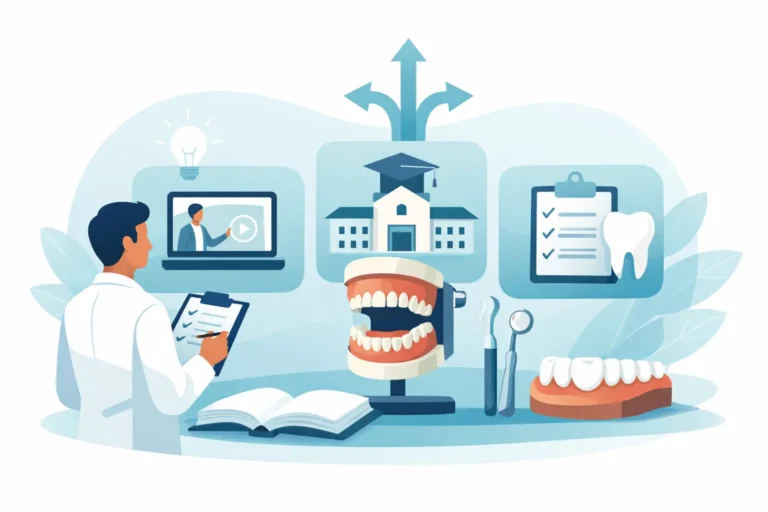
Use this bench exam course selection guide to compare feedback, curriculum, timing, and hands-on support before choosing U.S. dental training...
-
-
July 25, 2026

Learn what is bench exam evaluation, how U.S. dental schools score your work, and how targeted faculty feedback strengthens exam...
-
-
July 23, 2026