
Dental Bench Exam Course With Evaluation
You can watch hours of crown prep videos and still miss the one issue that costs points on exam day. For internationally trained dentists, that gap is rarely effort. It is calibration. A dental bench exam course with evaluation matters because bench exams are not judged on effort or general clinical experience. They are judged on specific criteria, under pressure, against U.S. expectations.
That is why passive learning often falls short. Bench exam preparation becomes more effective when your work is reviewed, measured, and corrected by faculty who understand how these exams are graded. If your goal is advanced standing admission or stronger U.S. bench exam readiness, the difference is not only what you practice. It is how your practice is evaluated.
What makes a dental bench exam course with evaluation different
A standard online course usually gives you content. A stronger system gives you content, submission requirements, written feedback, and a chance to improve based on faculty review. Those pieces change the learning process.
Bench skills are visual, tactile, and detail-sensitive. A preparation may look acceptable to you but still lose points for convergence, finish line design, reduction depth, or surface smoothness. Wax-ups, provisional work, Class II preparations, and endodontic access tasks all carry small technical errors that compound quickly under scoring rubrics. Without evaluation, many candidates repeat the same mistakes until exam day.
A dental bench exam course with evaluation creates a feedback loop. You study the procedure, complete the assignment, submit your work, receive structured comments, and then refine your technique. That sequence is what helps convert existing dental training into exam performance aligned with U.S. standards.
Why evaluation matters more than more practice hours
More practice is not always better if the technique is drifting away from the rubric. Many internationally trained dentists are clinically capable, but bench exams in the United States test more than basic competence. They test consistency, precision, and adherence to a specific preparation philosophy.
For example, a candidate may have strong hand skills but prepare a tooth according to habits developed in another educational system. On a U.S. bench exam, faculty may expect a different reduction pattern, wall form, margin definition, or overall geometry. If no one evaluates the work early, the candidate can become highly efficient at producing a result that still scores poorly.
This is where direct review becomes a strategic advantage. Evaluation identifies whether your result is acceptable, not just whether the procedure was completed. It also tells you why a preparation would gain or lose points. That level of clarity reduces uncertainty and helps you train with purpose.
What to look for in the evaluation process
Not all feedback has the same value. General comments like “improve taper” or “work on margins” are not enough for high-stakes exam preparation. Useful evaluation should be specific, rubric-based, and connected to visible criteria.
The strongest programs review work against the same categories candidates are likely to face in bench exams. That includes form, finish, dimensions, smoothness, wall relationship, contact management, and procedural accuracy. Written evaluation is especially helpful because it gives you a record of your errors and priorities for the next attempt.
Turnaround time also matters. If feedback arrives too late, practice momentum drops and technical memory fades. A defined review window supports disciplined progress. Resubmission matters too. One round of comments helps, but improvement usually happens when candidates correct the same exercise after feedback and learn how close they are getting to the target.
A course should train judgment, not just technique
One of the most overlooked benefits of evaluation is that it improves self-assessment. In the beginning, many candidates cannot reliably tell whether their work meets bench standards. They may overestimate an acceptable result or reject a preparation that is actually close to passing.
That uncertainty creates stress. It also makes independent practice inefficient.
A well-designed course helps candidates develop better judgment over time. After repeated faculty review, you start to see the same issues your evaluator sees. You begin to recognize under-reduction before submission, identify unsupported enamel earlier, and compare your finish lines more accurately against expected standards. This is a major shift because exam success depends not only on hand skills, but on your ability to monitor quality under time pressure.
The role of U.S. standards in bench exam preparation
Many dentists preparing for advanced standing or licensure-related assessments are adapting to a new clinical language. U.S. bench exam expectations are shaped by school-specific preferences, common grading patterns, and a strong emphasis on measurable criteria.
That means your preparation course should not feel generic. It should reflect the types of exercises, dimensions, and evaluation habits that candidates encounter in the U.S. setting. Faculty-calibrated demonstrations are important because they show the target outcome, not just the motion of the handpiece. Evaluation is important because it confirms whether your result actually matches that target.
This is one reason serious candidates look for a program that combines demonstration, assignment submission, and personal review. At Global Dental Elites Academy, that structure is central to the training model because it gives dentists a guided path to improve rather than leaving them alone with a video library.
Who benefits most from a dental bench exam course with evaluation
This type of course is especially valuable for three groups of candidates. The first is the dentist who has been practicing clinically for years but has limited familiarity with U.S. bench exam scoring. Experience is helpful, but it does not automatically translate into exam-specific performance.
The second is the candidate who has already practiced independently and still feels unsure whether the work is competitive. If your main question is “Am I doing this correctly?” evaluation answers that directly.
The third is the repeat applicant or retaker. In those cases, feedback becomes even more important because the issue is often not lack of effort. It is undetected inconsistency. A structured review process can expose patterns that self-practice misses.
Online evaluation vs in-person evaluation
Both formats can be effective, and the right choice depends on your stage of preparation. Online evaluation works well when you need flexibility, repeated submissions, and ongoing faculty feedback while building foundational consistency. It allows you to progress from your own location and still receive expert critique tied to exam criteria.
In-person evaluation becomes especially useful when you need pressure testing. Practicing under realistic time limits, with faculty observation and immediate correction, can reveal workflow problems that do not appear in home practice. Hand positioning, instrument organization, pacing, and stress management all become more visible in a live setting.
For many candidates, the strongest approach is progression. Build your fundamentals through a structured online course, then test those skills in a hands-on environment that simulates exam conditions. It depends on your timeline, budget, and current confidence level, but the common denominator remains the same: evaluation must be part of the process.
How to judge whether a course is worth the investment
A serious course should be transparent about what you receive. Look for clear procedural coverage, defined submission opportunities, personal faculty review, and a realistic explanation of how improvement is measured. If the course promises confidence but does not show how your work will be assessed, that is a weakness.
You should also consider the educational philosophy. Some programs mainly deliver information. Others build a system of performance correction. For bench exams, the second model is usually more useful because your challenge is not only learning what to do. It is learning how to do it to an acceptable standard, repeatedly.
Price matters, but value is not just the number of lessons. A lower-cost course without meaningful review can become expensive if it delays your readiness. A structured course with evaluation may require more commitment, but it often saves time by reducing guesswork and directing practice where it counts.
The real outcome is not feedback alone
Feedback by itself does not improve hand skills. Applied feedback does. The best candidates use evaluation as a training tool, not as reassurance. They compare comments across submissions, isolate recurring weak points, and make each practice cycle more intentional.
That is the practical advantage of a dental bench exam course with evaluation. It replaces uncertainty with measurable progress. You stop asking whether you practiced enough and start asking whether your work meets the standard.
When your goal is to earn a place in a U.S. dental program or move closer to licensure, that shift matters. The right training environment does more than show procedures. It helps you produce exam-ready work, with guidance strong enough to sharpen skill and calm enough to build confidence under pressure.
Choose the course that tells you the truth about your work, then use that truth to improve.
You May Also Like

Use this international dentist admission pathway guide to plan credentialing, bench exams, applications, and feedback-led preparation for U.S. programs.
-
-
July 27, 2026
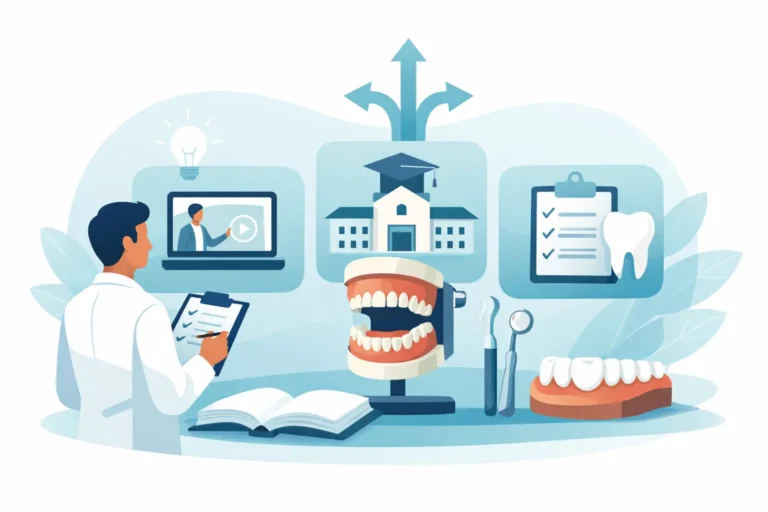
Use this bench exam course selection guide to compare feedback, curriculum, timing, and hands-on support before choosing U.S. dental training...
-
-
July 25, 2026

Learn what is bench exam evaluation, how U.S. dental schools score your work, and how targeted faculty feedback strengthens exam...
-
-
July 23, 2026