

Faculty Feedback for Dental Bench Exam Success
One margin that looks acceptable to you can still fail under a U.S. bench exam rubric. That is why faculty feedback for dental bench exam preparation matters so much. The issue is rarely effort. More often, it is calibration – knowing whether your reduction, outline form, finish line, taper, or surface smoothness would actually satisfy the examiner evaluating your work.
Internationally trained dentists usually arrive with strong clinical foundations. What creates difficulty is the shift from clinical experience to test performance under American expectations. A bench exam does not reward general competence alone. It rewards precise execution according to a narrow standard, within a time limit, under pressure, and with little room for interpretation. Without faculty review, many candidates keep practicing the same mistake until it becomes consistent.
Why faculty feedback for dental bench exam prep changes outcomes
Bench preparation is not only about repetition. It is about directed repetition. If you practice crown preparations, Class II restorations, endodontic access, or wax-ups without knowing exactly where your work falls short, you may improve speed while reinforcing the wrong habits.
Faculty feedback changes that pattern because it identifies the gap between what you intended and what an evaluator will see. That distinction is critical. A candidate may feel a prep has enough occlusal clearance, but the evaluator may see uneven reduction. A proximal box may appear clean, but the faculty reviewer may identify unsupported enamel, poor contact break, or an internal form that does not reflect exam criteria.
This is where serious preparation becomes more than watching demonstration videos. Demonstration shows the target. Feedback tells you whether you are actually reaching it.
For internationally trained dentists, this also reduces a major source of uncertainty. Many candidates are not asking, “Can I do dentistry?” They are asking, “Am I doing this the way a U.S. bench examiner expects?” Those are not the same question.
What strong faculty feedback actually looks like
Not all feedback improves performance. General comments such as “good work” or “needs refinement” are encouraging, but they do not tell you what to change on the next attempt. Effective faculty feedback is specific, standards-based, and actionable.
A useful review points to exact issues: insufficient lingual reduction, over-tapered axial walls, a finish line that lacks continuity, open margins in the provisional, rough internal line angles, or poor resistance form. It also explains priority. Some errors are cosmetic. Others are critical failures under exam grading.
That prioritization matters because candidates often try to fix everything at once. The result is overload. A calibrated faculty member helps you focus on the defects most likely to lower your score, then improve them in sequence.
Strong feedback also includes comparison against a recognizable standard. That means the comments are not based on personal preference alone. They reflect exam-style criteria and the level of consistency expected in U.S. dental school bench testing. This is where expert review carries real value. You are not just receiving opinion. You are receiving evaluation anchored to performance.
The best feedback loop is submit, review, correct, resubmit
One-time feedback can help, but real improvement usually comes from a structured cycle. You complete the procedure, submit your work, receive written evaluation, make corrections, and then resubmit. That loop forces active learning.
This matters because bench skills are visual and manual. You cannot fix a depth problem or convergence issue by reading about it once. You need to apply the correction and then confirm that the correction was successful. Otherwise, candidates often think they improved when they only changed the appearance of the work, not the underlying geometry.
The resubmission stage is where confidence begins to become earned. If your first prep showed inconsistent reduction and poor finish line definition, and your second version demonstrates measurable improvement after review, you are no longer guessing. You are building proof.
That proof becomes especially important close to exam day. Anxiety rises when candidates do not know whether their work is truly acceptable. Structured faculty review reduces that uncertainty because progress is visible. You can track whether errors are decreasing, whether your timing is improving, and whether your work is becoming more exam-ready.
Common areas where candidates need faculty correction
Most bench exam candidates do not fail because they lack intelligence or commitment. They struggle because small technical deviations carry large scoring consequences. Faculty often identify recurring problems in reduction depth, path of insertion, proximal clearance, margin placement, surface smoothness, and overall preparation balance.
Another common issue is inconsistency across attempts. A candidate may produce one strong preparation and then two weak ones. That usually means the skill is not yet stable under timed conditions. Faculty feedback helps distinguish between occasional success and repeatable performance.
Time management is another area where review helps. Some candidates spend too long perfecting one surface and compromise the rest of the exercise. Others rush and leave avoidable defects. A faculty reviewer can often tell whether the issue is purely technical or whether it reflects a pacing problem.
There is also a deeper adjustment that many internationally trained dentists must make: shifting from a clinical mindset to an exam mindset. In practice, there may be several clinically acceptable approaches. In a bench exam, the acceptable range is often narrower. Faculty guidance helps you adapt without second-guessing every move.
Why self-assessment alone is usually not enough
Self-assessment has value, especially when candidates learn to use checklists and rubrics. But self-assessment without expert calibration has limits. The closer your work gets to borderline quality, the harder it becomes to judge objectively.
That is where many candidates lose time. They know enough to see obvious errors, but not enough to identify subtle ones that examiners notice immediately. They may overcorrect one issue and create another. For example, trying to improve retention form can lead to under-reduction, or chasing more clearance can weaken structural design.
Faculty review protects against that kind of drift. It keeps your improvement aligned with exam priorities rather than personal habit. It also shortens the trial-and-error phase, which is critical when your preparation window is limited.
How to use faculty feedback well
Receiving feedback is not the same as using it well. The candidates who improve fastest usually treat every review as a performance document. They do not read comments once and move on. They compare the comments to their submitted work, identify patterns, and carry those corrections into the next exercise.
It helps to look for repeated errors across procedures. If different assignments reveal over-taper, weak margins, or inadequate refinement, that is not a one-time issue. It is a pattern that needs focused correction. This is where disciplined preparation makes a difference. You should know your top two or three recurring weaknesses at all times.
It also helps to separate critical errors from finishing details. Surface polish matters, but not as much as fundamental reduction or margin integrity. A strong faculty reviewer will guide that distinction. A strong student will follow it.
Finally, use feedback early enough for it to matter. Last-minute review can identify problems, but it may not leave enough time to rebuild your technique. The best results come when feedback is part of training from the start, not an emergency check near the exam.
What to look for in a training program
If you are choosing a bench exam course, ask whether the feedback process is truly faculty-led, whether comments are written and specific, whether resubmissions are included, and whether the evaluation reflects actual U.S. bench standards. Those details matter more than a large video library.
A passive course may show beautiful demonstrations but leave you alone with your errors. A serious program gives you correction, not just content. That is one reason many candidates look for structured review models such as those offered by Global Dental Elites Academy, where training is built around demonstration, submission, evaluation, and measurable improvement.
The right program should make your weaknesses visible without making the process discouraging. Serious feedback is direct, but it should also be constructive. You need clarity on where you stand and confidence that you can improve.
Bench exam preparation gets better when it becomes less mysterious. Once you understand how your work is being judged, and once a calibrated faculty member shows you how to close the gap, practice starts serving a purpose. That is when repetition stops being exhausting and starts becoming progress.
You May Also Like

Use this international dentist admission pathway guide to plan credentialing, bench exams, applications, and feedback-led preparation for U.S. programs.
-
-
July 27, 2026
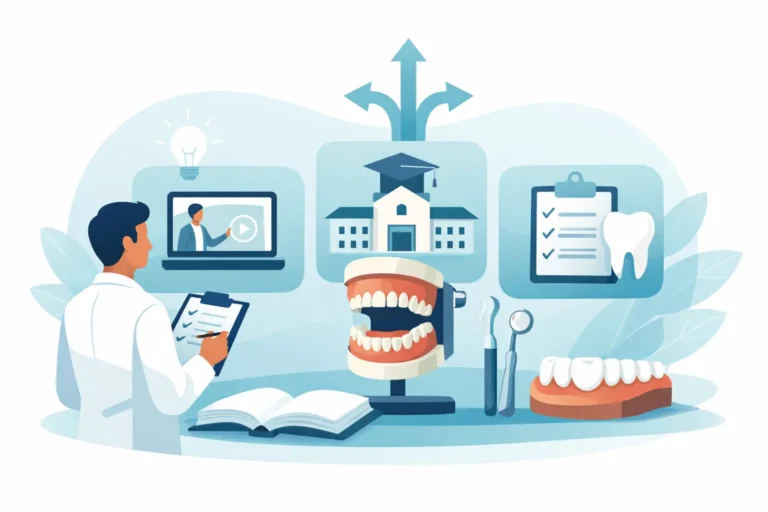
Use this bench exam course selection guide to compare feedback, curriculum, timing, and hands-on support before choosing U.S. dental training...
-
-
July 25, 2026

Learn what is bench exam evaluation, how U.S. dental schools score your work, and how targeted faculty feedback strengthens exam...
-
-
July 23, 2026